Singapore Prime Minister Predicts Tech Market Correction
Singapore Prime Minister Lawrence Wong warned that the AI-driven tech rally will eventually face a market correction and urged the nation to prepare for a potential downturn.

Singapore Prime Minister Lawrence Wong warned that the AI-driven tech rally will eventually face a market correction and urged the nation to prepare for a potential downturn.

Despite 10-year Treasury yields hitting a 24-year high, US economic growth of 8.5% continues to outpace the 3.4% average interest rate on government debt.

Data analysis reveals that the US has successfully decoupled economic growth from carbon emissions since the 2008 financial crisis, following a model previously established by Sweden.

The IMF projects 4.5% GDP growth for El Salvador in 2026 and has approved a new $140 million disbursement despite a breach of Bitcoin accumulation requirements.

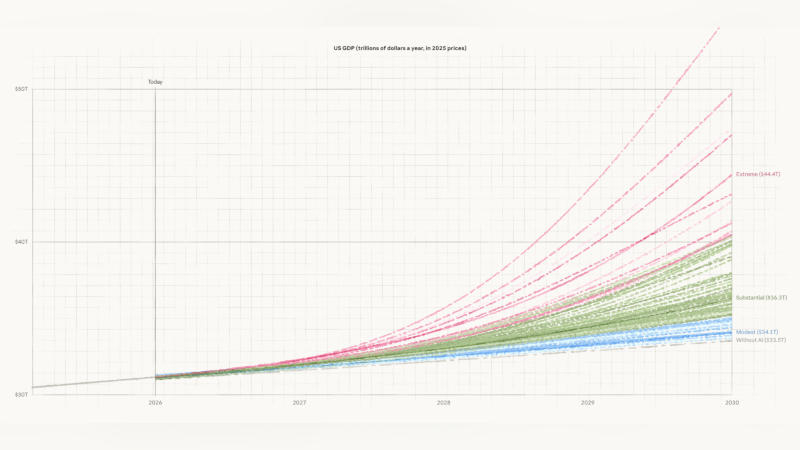
Anthropic released a report modeling three potential US economic futures by 2030, highlighting significant shifts in labor markets and GDP growth driven by AI adoption.

Brazil is set to reach a 97.3 percent public debt-to-GDP ratio by 2026, marking the highest level in Latin America.

The OECD has slightly raised its 2026 global growth forecast to 2.9%, citing AI infrastructure investment as a buffer against energy supply shocks.

ARK Invest CEO Cathie Wood suggests that technological innovation will curb inflation and drive GDP growth beyond historical norms, despite recent Federal Reserve rate hikes.

Australia has released a 40-year economic blueprint, positioning artificial intelligence as the core engine to double the nation's GDP by the mid-2060s.

France's draft 2027 budget projects public debt to reach 121.7% of GDP, with the government aiming to reduce the deficit to 5% amid rising tax burdens.

US retail sales rose by 1.2% in August, rebounding from a July decline, with a 1.4% increase in the control group signaling potential growth in third-quarter GDP.

China's August economic data missed analyst forecasts across retail, industrial, and investment sectors, while real estate investment contracted by 12.9%.

Anthropic released an economic model predicting that AI adoption could boost U.S. GDP by up to 32.4 percent, reaching $44.4 trillion within four years, while potentially displacing knowledge workers.

The British pound hit a one-month low against the dollar on September 14, driven by rising oil prices and expectations of a Federal Reserve rate hike.

Anthropic has modeled three potential economic outcomes for the US by 2030, ranging from moderate growth to massive labor market disruption driven by AI.

UK GDP growth reached 0.4% in July, driven by AI and tech investments, making Britain the fastest-growing G7 economy in the first half of 2026.

Anthropic's 2026 economic analysis suggests that while AI adoption could significantly boost GDP, it may also lead to declining wages for cognitive workers and a shift in income toward capital owners.

Anthropic released an economic model predicting 15% annual GDP growth and 20% office worker unemployment by 2030, while the company maintains a valuation of $965 billion.

The European Central Bank has increased interest rates by 25 basis points and released new macroeconomic projections amid geopolitical uncertainty.

Goldman Sachs analysts caution that the economic impact of AI is currently overstated, noting that infrastructure spending has yet to drive significant US GDP growth.