

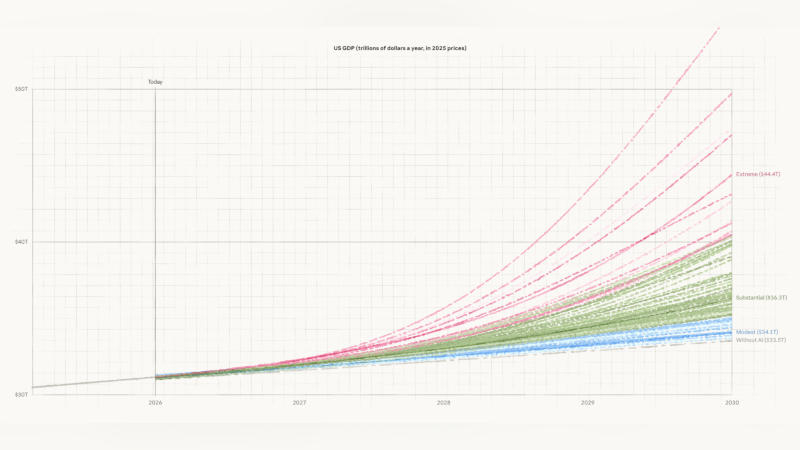
Anthropic has outlined three potential models for the impact of artificial intelligence on the US economy by 2030: restrained, substantial, and extreme. The realization of these scenarios depends on the pace of AI advancement and the methods of its integration into existing workflows.
The restrained scenario suggests an impact comparable to the internet, with steady innovation and moderate economic gains. In the substantial model, AI handles half of all cognitive tasks, potentially doubling US GDP growth from 2–2.5% to 4–5% annually. Most tasks would still be performed manually.
The extreme model envisions AI outperforming humans in most cognitive tasks, leading to autonomous operations and a 15% annual GDP growth rate, which would double the economy in 4.5 years. This path, however, risks unprecedented unemployment as demand for human cognitive labor drops.
An August survey conducted by Anthropic shows that most respondents expect the substantial scenario to prevail by 2030, projecting a 10% higher GDP compared to a non-AI baseline and an unemployment rate of approximately 5%. Only 10% of those surveyed anticipate the extreme model.



