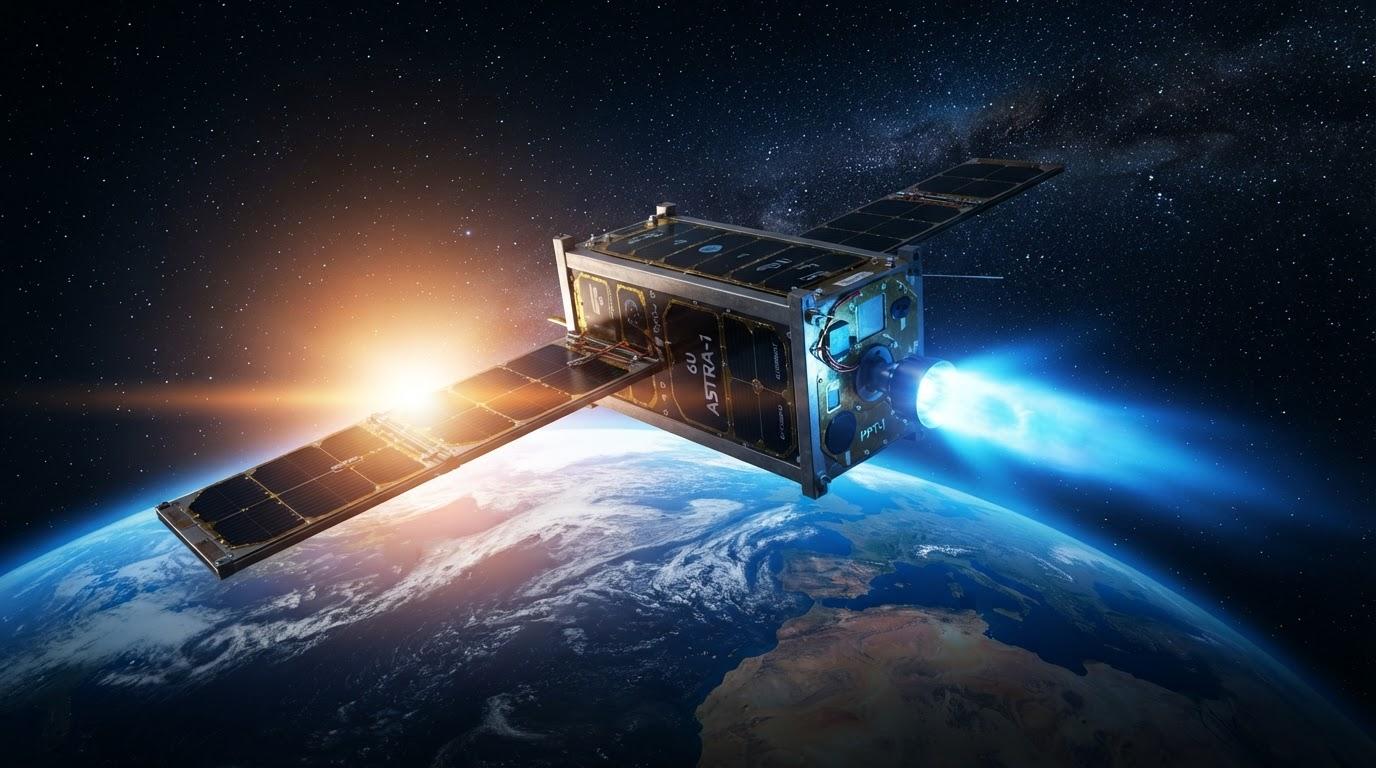
Engineers from the Moscow Aviation Institute and Samara University have developed a pulsed plasma engine designed for nanosatellites weighing up to 10 kg. The system utilizes a flexible fuel configuration, allowing gas tanks to be placed anywhere within the satellite, connected to the engine via thin pipelines to optimize internal space.
The propulsion system operates through electric plasma acceleration and features a high-speed electromagnetic valve with a thin magnetic membrane. This design eliminates friction-prone components, aiming for increased durability. The valve is rated for over one million cycles, supporting approximately 300 hours of active orbital maneuvering.
The engine enables nanosatellites to perform autonomous maneuvers, maintain orbits, and compensate for atmospheric drag. These capabilities allow small satellites to maintain precise relative positioning, potentially replacing larger, more expensive spacecraft for Earth observation and monitoring tasks such as tracking cyclones or forest fires.
Future applications include forming distributed space telescopes or antennas by linking multiple maneuvering nanosatellites into a single interferometer with a baseline of thousands or millions of kilometers. Such systems could assist in studying black holes, searching for extraterrestrial life, or observing solar activity to improve space weather forecasting.