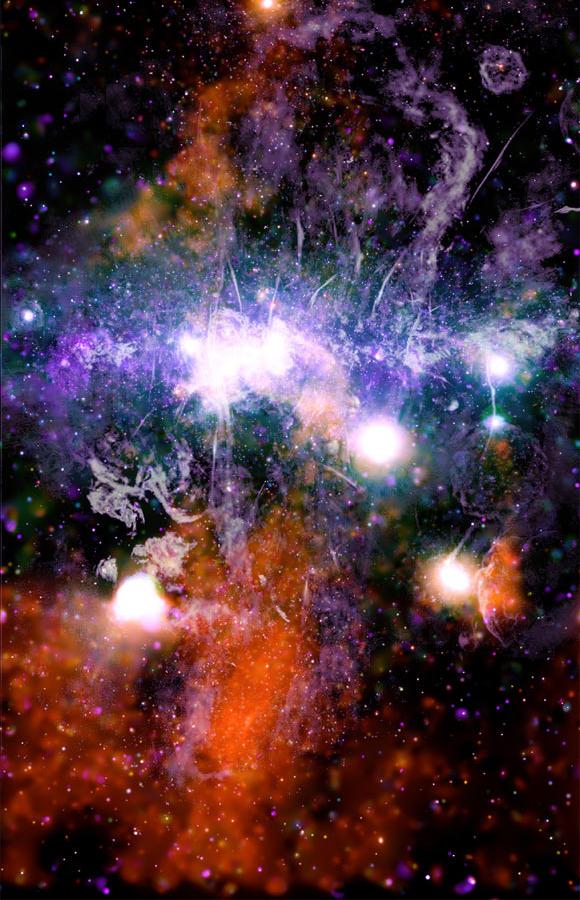
Astronomers utilized the James Webb Space Telescope to analyze gas clouds near Sagittarius A*, the supermassive black hole at the center of the Milky Way. Observations focused on a region spanning 0.1 parsecs, or approximately one-third of a light-year. The study employed the MIRI medium-resolution spectrograph to examine the chemical composition and physical state of the gas.
The data revealed that the gas is enriched with metals at approximately 1.8 times the solar level. Researchers identified neon, argon, sulfur, nickel, and iron within the structures. The analysis focused on the mini-spiral, specifically its bar, the Northern Arm, and compact, fast-moving gas clumps. These regions exhibit varying levels of ionization, suggesting different energy sources or physical impacts.
The presence of nickel and iron in the gas phase indicates significant dust destruction, likely caused by shock waves. While massive Wolf-Rayet stars are considered primary sources of ionizing radiation, the researchers noted that high-speed shocks may also affect the compact clumps. These findings are essential for refining models of gas cooling and accretion near the black hole.
A separate study published in The Astrophysical Journal attempted to trace past activity of Sagittarius A* through the surrounding gas. However, the researchers concluded that local physical conditions significantly obscure the signatures of historical outbursts. Consequently, these gas structures cannot currently serve as a reliable record of the black hole's past activity.