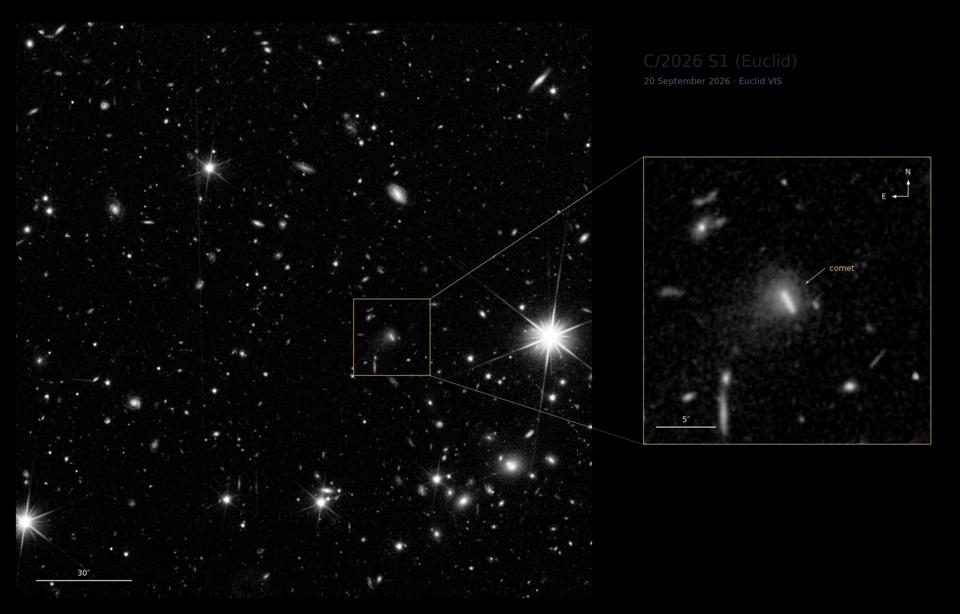
The Euclid space telescope has identified a new comet, designated C/2026 S1 (Euclid), located approximately 1.3 billion kilometers from Earth. The object was captured in images taken between September 16 and 24. It follows an orbit that takes thousands of years to complete and travels well above the plane of the solar system.
The discovery was made by Mikko Pontinen, a doctoral student at the University of Helsinki, using custom software designed to detect moving objects in Euclid's data. The comet was identified across 16 exposures in five survey fields. The International Astronomical Union officially confirmed the finding on October 8.
Euclid is primarily tasked with mapping billions of galaxies over a six-year period to study dark matter and dark energy. The telescope typically avoids the asteroid-rich plane of the solar system to minimize interference from interplanetary dust. This discovery serves as a test for detection procedures relevant to the upcoming Comet Interceptor mission.
While Euclid has previously imaged known comets, C/2026 S1 is the first one discovered directly by the telescope. Although this specific comet is not a target for the Comet Interceptor mission, the data processing and coordination methods developed during this event will be applied to future collaborative efforts by the European Space Agency.