Topological Photonics: Advancing Computing Beyond Traditional Limits
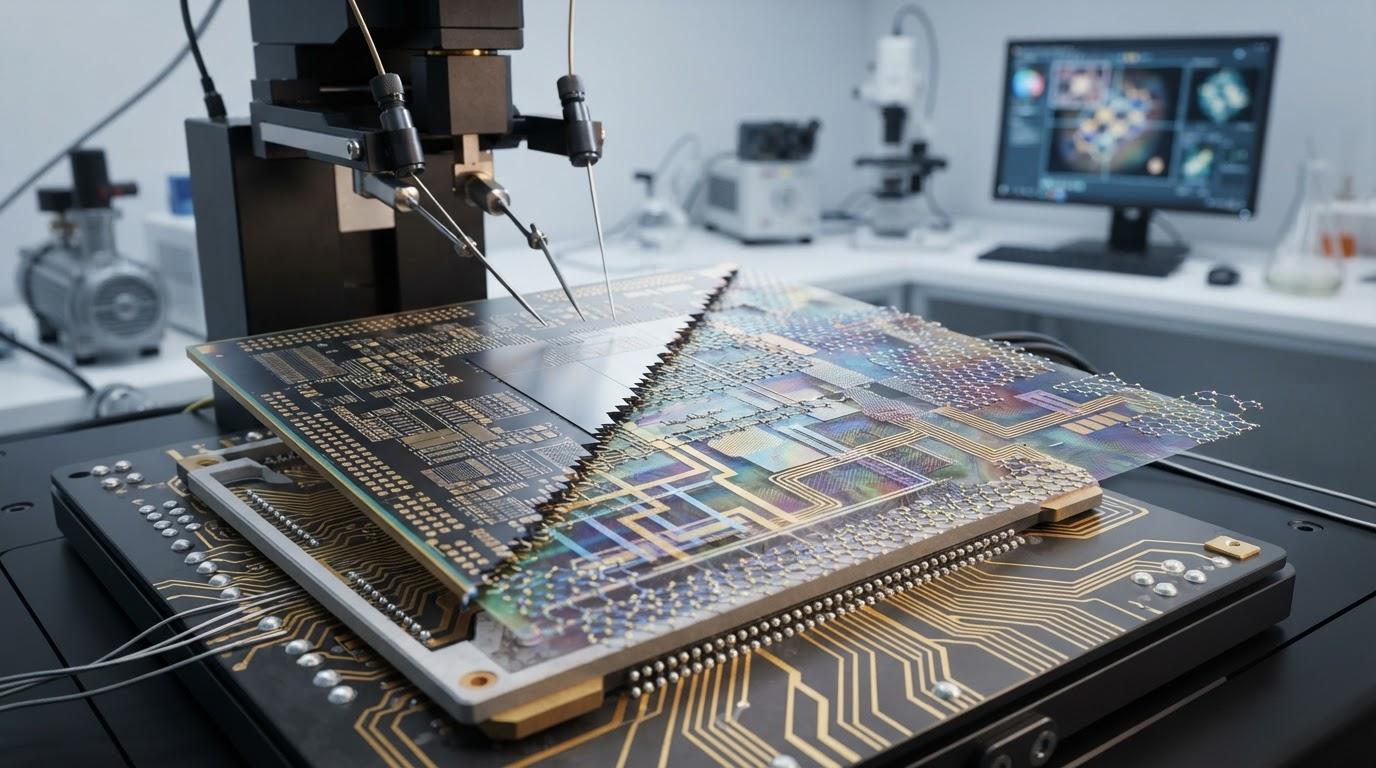
Topological photonics is emerging as a promising field for developing next-generation computing systems that bypass the constraints of traditional von Neumann architecture.

Topological photonics is emerging as a promising field for developing next-generation computing systems that bypass the constraints of traditional von Neumann architecture.

Semiconductor startup Volantis has raised $88 million to develop photonic interconnects that aim to overcome memory bottlenecks in AI inference.

Researchers from HSE University and the Shandong Academy of Sciences have established a new method to measure and compare the performance of microdisk lasers for photonic chips.
Shvabe and MIPT have partnered to develop energy-efficient electronics and photonics using materials only a few atoms thick.

Shvabe and MIPT have partnered to develop energy-efficient microelectronics and photonics, focusing on advanced materials for processors, memory, and sensors.
Mizuho Securities has initiated coverage of Tower Semiconductor with a $300 price target, citing the company's strong position in the AI optical connectivity market.
Researchers from the Russian Quantum Center and partner universities have proposed a photonic quantum architecture that uses classical memory to store intermediate results.

French startup Lightspring has raised over €3.5 million to industrialize its 3D-fabricated photonic integration platform for AI infrastructure.

French startup Lightspring has raised over €3.5 million in combined equity and grant funding to industrialize its 3D lithography process for photonic chip manufacturing.

Researchers have successfully trapped hybrid light particles using perovskite metasurfaces, paving the way for optical processors that could outperform current electronics by hundreds of times.

Singular Photonics has introduced Litavis, a SPAD-based sensor that performs on-chip data processing to enable picosecond-level photon analysis for industrial and scientific applications.

Xanadu and ASML are partnering to develop advanced lithography processes to scale fault-tolerant photonic quantum computers.

Fujitsu has unveiled a working quantum computer prototype using diamond spin qubits and photonic circuits, targeting 1,000 logical qubits by 2035.

Sparrow Quantum and Ruhr University Bochum have developed a photon source generating over 500 million photons per second for quantum computing and metrology applications.

Researchers from Sweden and the UK have created a flat optical fiber called HARFF that is up to 1,000 times more sensitive than traditional round fibers.