

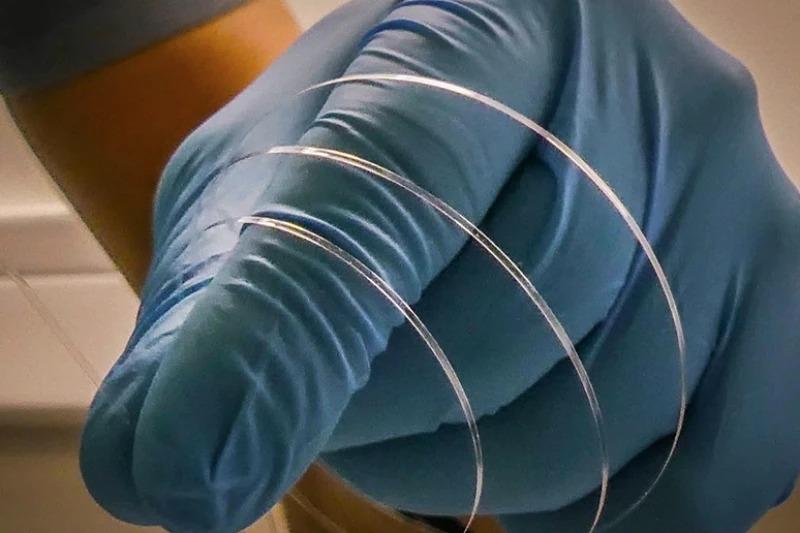
The researchers developed a flat ribbon fiber called HARFF (High Aspect Ratio Flat Fiber). It is up to 1,000 times more sensitive to physical impacts than traditional cylindrical light guides. The team has already produced over 120 meters of this fiber from a single preform, demonstrating its technical feasibility.
The technology is based on a specific geometry where the preform is shaped as a flat ribbon with an aspect ratio of up to 20:1. This allows engineers to independently design internal channels, air cavities, and waveguide position, controlling where the glass bends or resists.
For pressure sensors, the team created two elongated air channels. Deformation of these channels creates asymmetric stress and changes the birefringence of the glass. Two identical fiber Bragg gratings form an optical resonator, shifting the interference pattern proportional to the pressure.
Tests at 0.40 MPa showed a sensitivity of up to 31.6 rad/MPa, which is three orders of magnitude higher than comparable round fiber. Temperature cross-sensitivity is less than 1% of the pressure. For temperature measurement, the internal channel was filled with a tin alloy with a thermal expansion coefficient 46 times higher than silica.
The HARFF fiber is currently a laboratory sample with optical losses of approximately 0.16 dB/m. The developers aim to improve shape control and reduce losses to integrate the fiber into drone wings, bridges, industrial structures, and batteries.


