

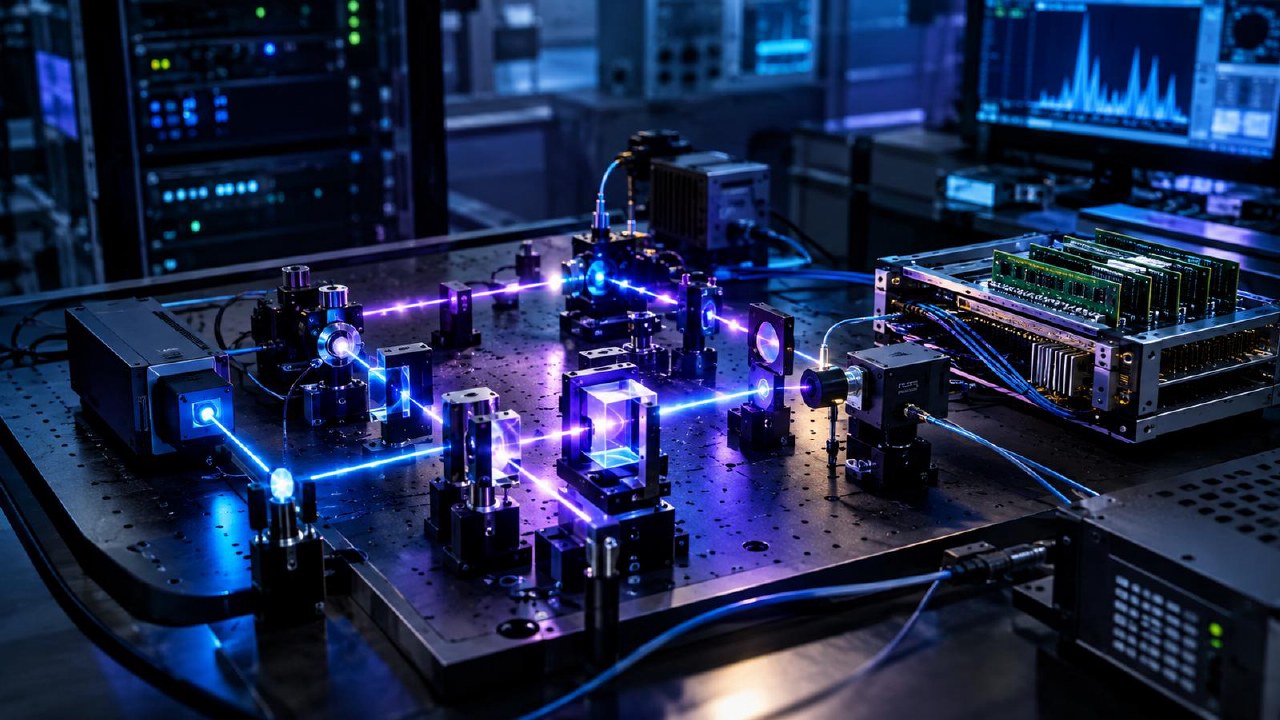
Researchers from the Russian Quantum Center, Moscow State University, and Ural Federal University have developed a theoretical model for a photonic quantum system. The architecture integrates classical electronic memory to store intermediate computational results, allowing the device to adjust operations based on previous measurements.
The system utilizes a closed-loop optical design where photons traverse the same path multiple times. A detector captures a portion of the photons after each cycle, with the resulting data stored in classical memory. This information helps evaluate the system state before proceeding to the next calculation step.
Calculations indicate that storing the entire history of operations is unnecessary, as tracking only the most recent measurements suffices. In one specific scenario, this approach reduced the number of potential outcomes for subsequent measurements from five to two.
This architecture aims to support quantum algorithms that require real-time responses to intermediate data, such as error correction and iterative refinement. The design avoids the need for complex quantum memory by leveraging existing optical technologies.
The findings were published in the journal Physical Review A. The research is currently theoretical, and the team plans to proceed with experimental verification of the proposed principle in future work.

