

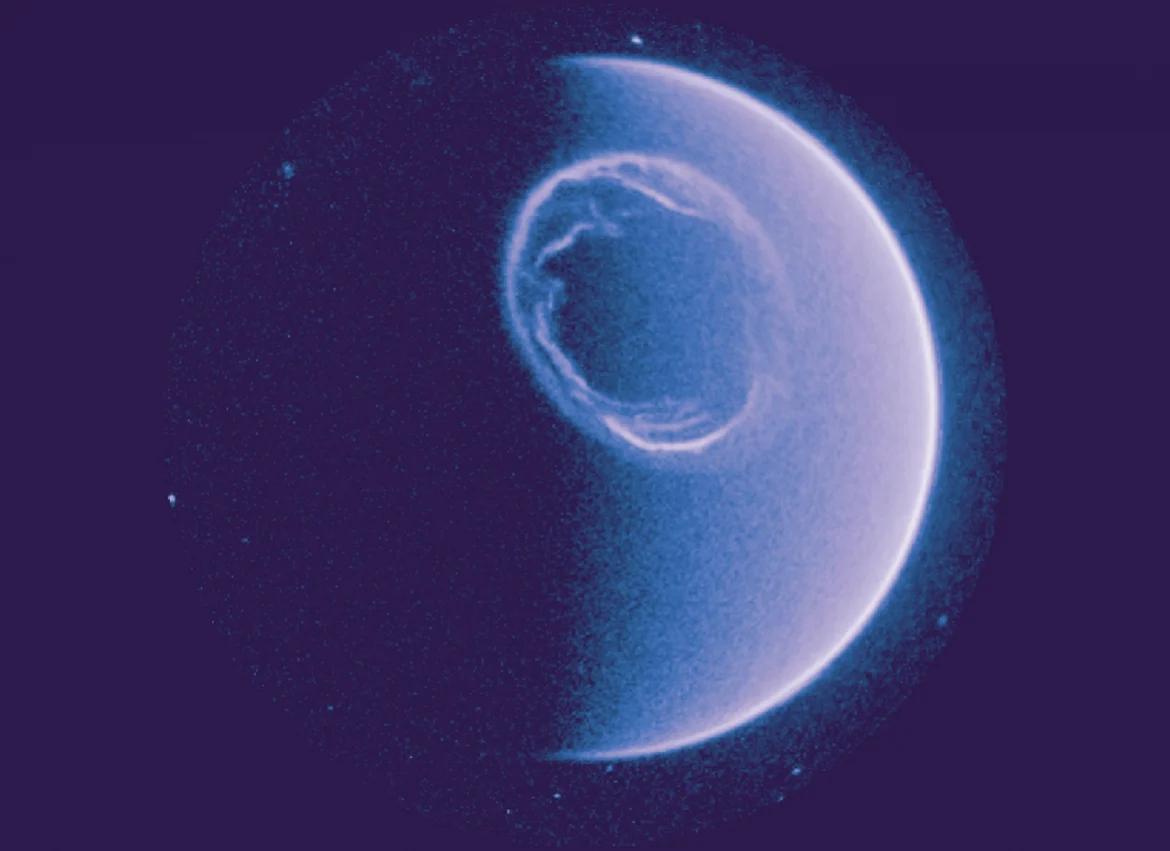
The SMILE mission, a joint project between the European Space Agency and the Chinese Academy of Sciences, has officially commenced scientific operations. The spacecraft, launched on May 19 via a Vega-C rocket from Kourou, French Guiana, reached its operational orbit on June 20 following 12 maneuvers.
The orbit features an inclination of 73 degrees, with an apogee of 120,920 km and a perigee of 5,027 km. For approximately nine months each year, the satellite will spend significant time at high altitudes, enabling continuous monitoring of Earth's polar regions and magnetic field.
The onboard suite includes the UVI ultraviolet camera, the SXI soft X-ray telescope, the LIA light ion analyzer, and a MAG magnetometer. The UVI camera has already captured a full ring of auroras around the North Pole, marking the first such ultraviolet observation since 2008.
The UVI instrument is capable of continuous aurora monitoring for up to 45 hours. Meanwhile, the SXI telescope has captured initial X-ray images of Cassiopeia A and a supernova remnant in the Large Magellanic Cloud, with further adjustments underway to optimize Earth observations.
The primary mission duration is set for three years, with a potential for extension. The project aims to study the interaction between solar wind and Earth's magnetosphere to better understand space weather phenomena, including magnetic storms and the formation of auroras.



