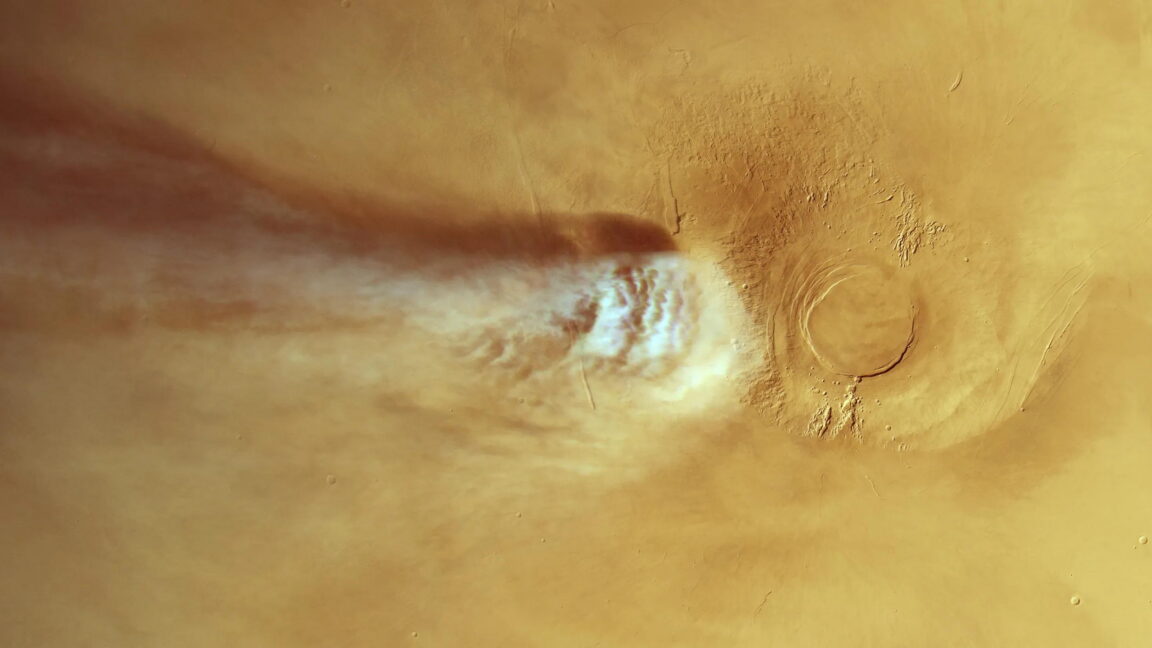
The Arsia Mons Elongated Cloud (AMEC) on Mars, first documented by a probe in 2018, has long puzzled researchers. A recent study published in Nature Geoscience provides the first successful model of its formation, suggesting the cloud is driven by a physical process previously unobserved in planetary atmospheres.
The research team, led by Jorge Hernández-Bernal of Sorbonne Université, indicates that the cloud forms through homogeneous nucleation. Unlike typical cloud formation on Earth, which requires dust or salt particles, this process involves water vapor transitioning directly into ice crystals without external debris.
The phenomenon requires extreme conditions, including a 30 degree Celsius temperature drop within 10 minutes and high relative humidity. The 65 000-foot-tall Arsia Mons volcano triggers this by creating waves that force moist air into the upper atmosphere. The required humidity levels are over 100 000 times higher than those measured on Earth.
While scientists have theorized that such processes might occur on other planets, including Earth and Venus, this is the first time the phenomenon has been modeled. The study confirms that these specific humidity levels exist on Mars, providing new insights into the Martian atmosphere.