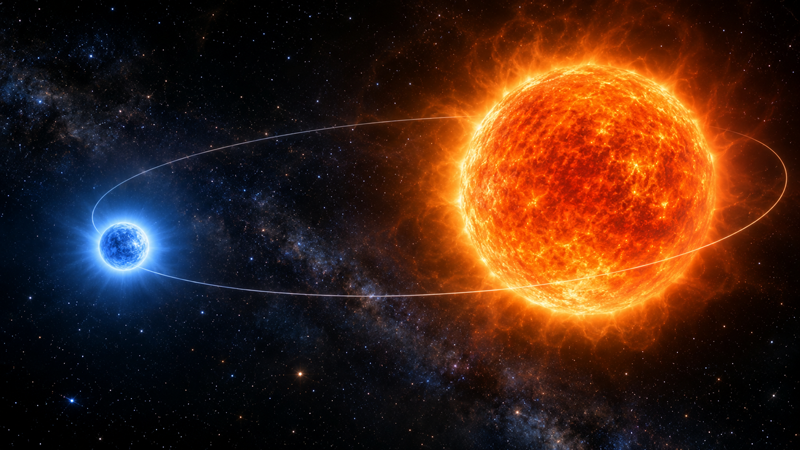
Astronomers have identified a compact, invisible object designated J0008+0128, located several thousand light-years away. The object, which measures approximately 20 km, was detected through spectroscopic and astrometric analysis of its binary system partner, a red giant star.
Data from the Gaia satellite, along with observations from LAMOST, SDSS/APOGEE, and the Nordic Optical Telescope, indicate the red giant has a mass of 1.2–2.7 solar masses. The invisible companion is estimated to have a mass between 1.8 and 2.8 solar masses.
The system has an orbital period of approximately 1220 days with an eccentricity of about 0.1. Researchers note that the orbital distance is too large for the companion to have gained mass from the red giant, challenging current stellar evolution models.
Thousands of simulations using the POSYDON framework failed to replicate the observed characteristics of J0008+0128. Scientists hypothesize the object could be an exceptionally massive neutron star, potentially formed through a supernova or the merger of a triple system.