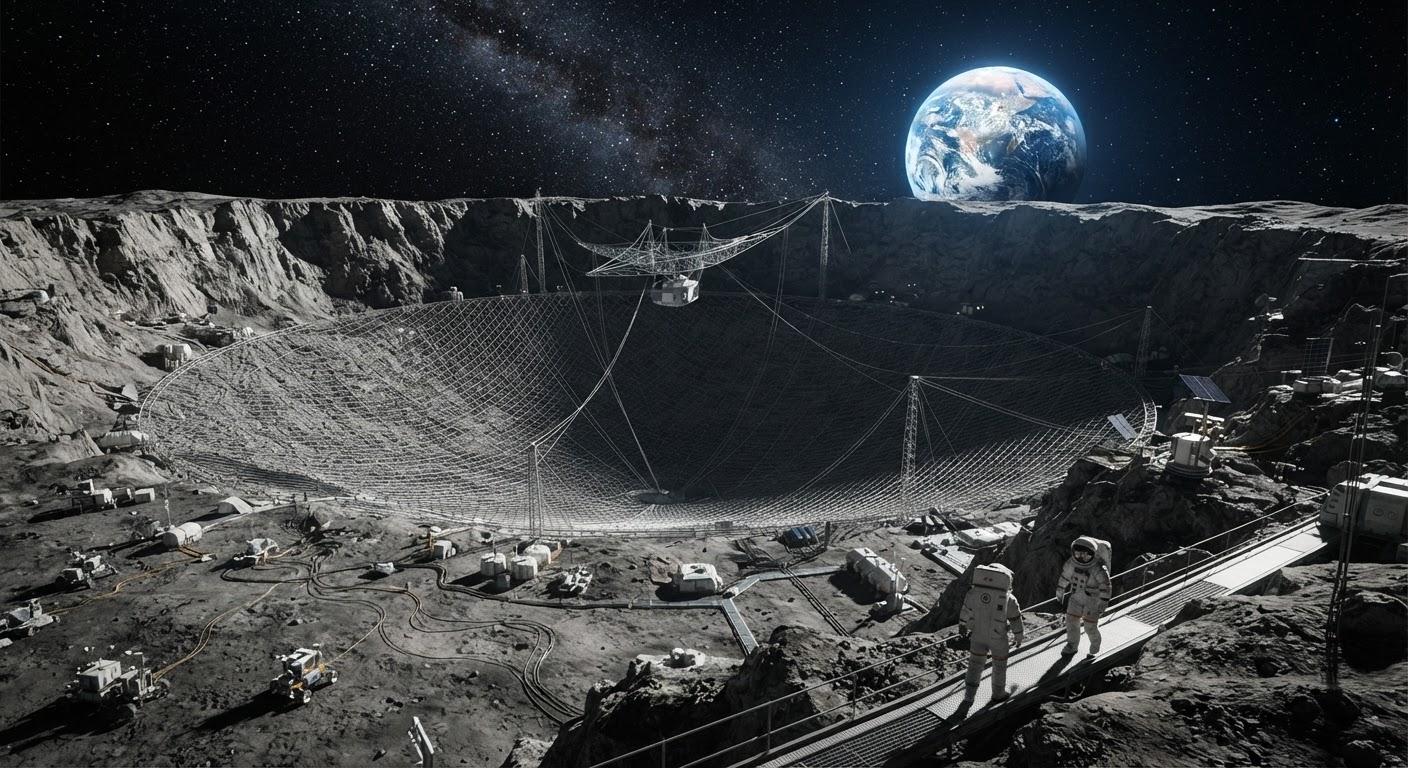
Elon Musk has proposed utilizing the Starship spacecraft to deploy significantly larger space telescopes and establish observatories on the lunar surface. The billionaire suggests that the system's capabilities will fundamentally alter the approach to astronomical missions by expanding the aperture of physical research.
The Starship system is designed to carry over 100 tons of payload into orbit. Its hull diameter of approximately 9 meters provides substantial space for scientific equipment, which is critical for telescope construction. This capacity could eliminate the need for complex folding mechanisms required by current telescopes like the 6.5-meter James Webb.
Larger mirrors allow for the collection of more light, enabling the observation of distant and faint objects. Musk also highlighted the potential of the Moon's far side for astronomical research, as it remains shielded from terrestrial radio interference.
NASA has previously explored the Lunar Crater Radio Telescope concept, which involves placing a mesh reflector inside a lunar crater. Such a facility could operate at frequencies below 30 MHz, which are blocked by Earth's ionosphere, to study the early universe before the formation of stars.