

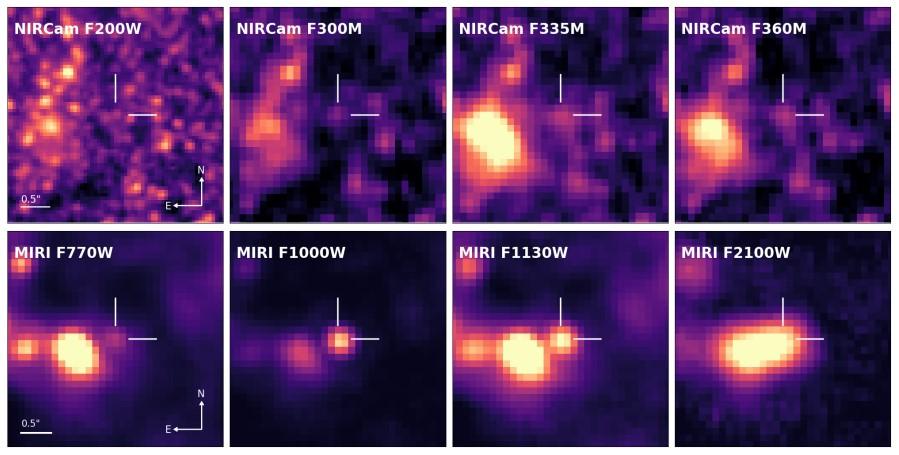
Researchers analyzed archival data from the James Webb Space Telescope (JWST) regarding the supernova SN 1983V, which was first detected in November 1983 within the NGC 1365 galaxy. Observations were conducted using the MIRI and NIRCam instruments more than 14,141 days after the initial explosion.
The analysis revealed a powerful infrared source with an unusually smooth spectral energy distribution. Scientists identified two dust components: a hot silicate component at approximately 630 Kelvin with a mass of 1.8 × 10⁻⁶ solar masses, and a cold carbon component at 173 Kelvin with a mass of approximately 7.7 × 10⁻³ solar masses.
This mass measurement represents one of the largest dust reservoirs ever recorded for a supernova with an ejected shell. The data suggests the dust is likely arranged in a torus shape, a structure potentially formed by interactions within a binary star system prior to the explosion.
The team proposes that the dust is being heated by the expansion of the supernova's shock wave through direct collisions. The estimated radius of this dust ring ranges from several hundred to several thousand astronomical units, a scale comparable to the inner region of the Oort cloud.
Previous attempts to detect radio emissions via the VLA or X-ray signals using Chandra and XMM-Newton were unsuccessful. Future spectroscopic observations with the JWST are planned to further investigate the composition and heating mechanisms of this cold dust cloud.



