

Huawei executive Yu Chengdong confirmed that extreme ultraviolet lithography (EUV) equipment is essential for manufacturing advanced chips. He noted that China is currently developing its own EUV technology, while domestic production remains reliant on deep ultraviolet (DUV) lithography.
To address limitations in accessing advanced process nodes, Huawei employs a system engineering approach. This strategy focuses on optimizing overall performance across various smartphone components, as not all parts require the most advanced manufacturing processes.
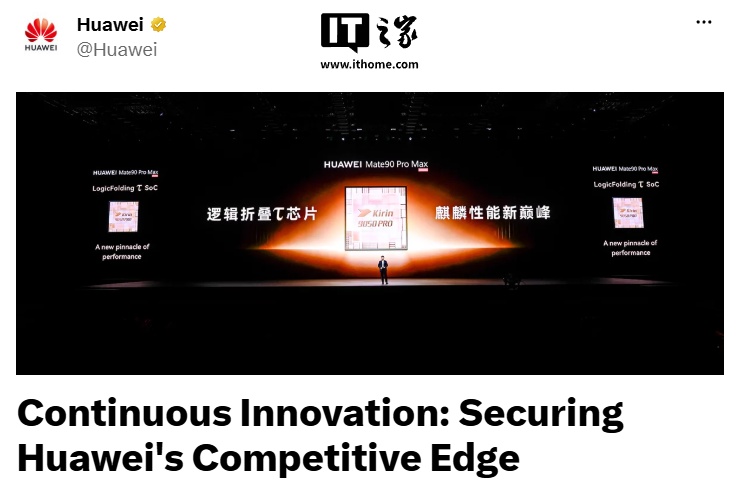
The company introduced the Logic Folding technology, which aims to improve performance by compressing signal propagation delays and increasing transistor density. This method is part of the broader 'Tau Law' framework, which substitutes geometric scaling with time-based scaling.
The Mate 90 series, launched on October 1, features the Kirin 9050 and Kirin 9050 Pro chips based on this architecture. The system optimizes performance across device, circuit, chip, and system levels, including the use of the Lingqu bus for reduced communication latency.
Huawei projects that by 2031, chips developed under the Tau Law framework will achieve transistor densities equivalent to those produced using 1.4-nanometer process technology.

