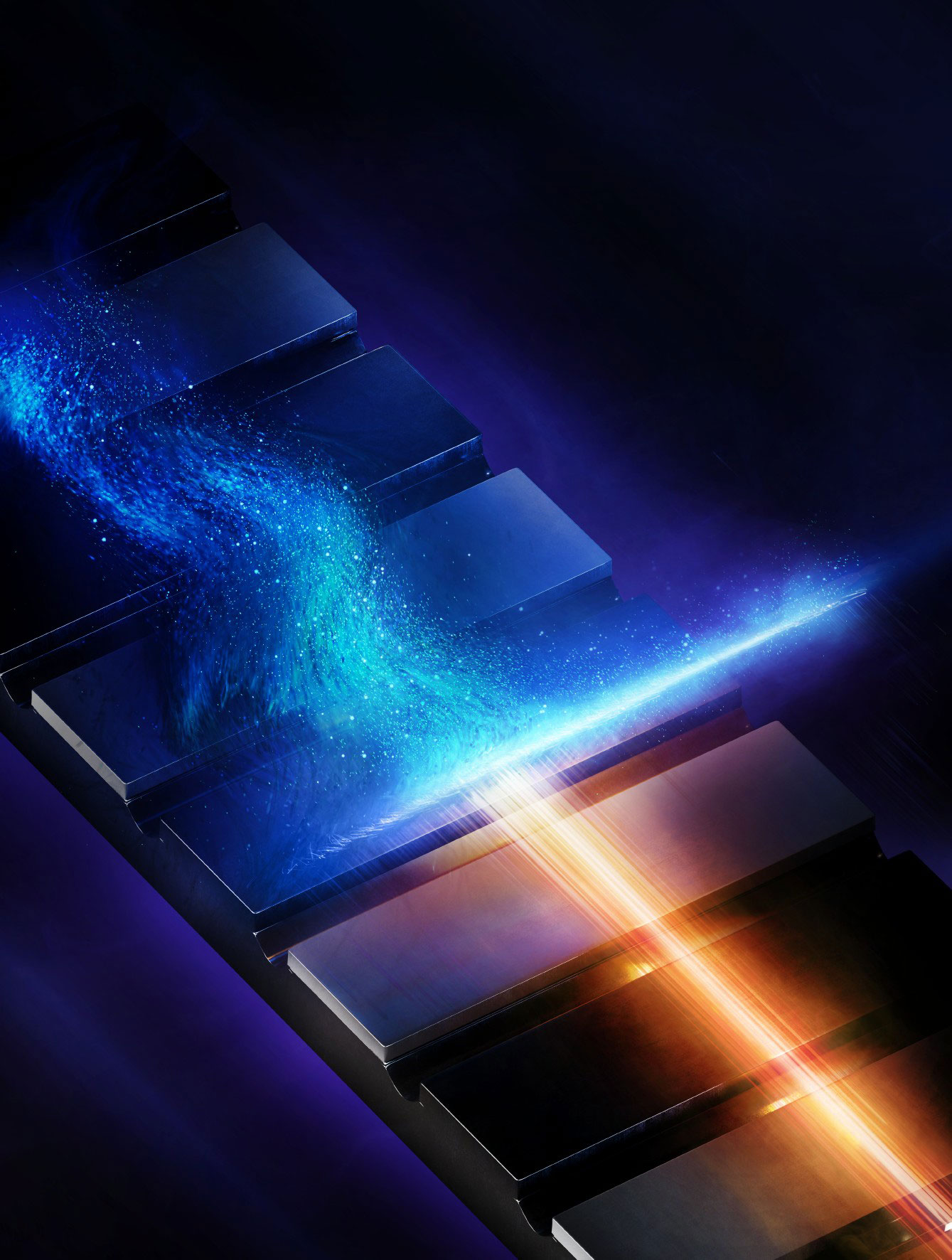
The European XFEL research team has achieved a world record for hard X-ray pulse intensity and energy density. The experiment, conducted in April 2026 at the facility's MID station, generated pulses lasting approximately 300 attoseconds. These ultra-short flashes allow for the observation of electron dynamics within atoms and molecules with unprecedented precision.
To achieve this, researchers utilized an advanced Kirkpatrick-Baez (AKB) optical system from Japan. The system focused the X-rays into a tiny area measuring 180 by 330 nanometers, which is roughly one hundred-thousandth of the cross-section of a human hair. The resulting peak intensity is estimated to exceed 10^20 watts per square centimeter.
The team verified these intensity levels by observing amplified spontaneous emission (ASE) in copper foil samples. As pulse energy increased, the ASE signal showed a saturation effect, which occurs only under extremely high X-ray intensities. This phenomenon provided independent confirmation of the calculated energy density and peak intensity records.
The facility plans to install its own dedicated AKB focusing system by early 2027. Once operational, this upgrade will enable global research teams to conduct experiments using these high-intensity, attosecond-duration pulses. The technology is expected to advance fields such as ultrafast physics, materials science, and chemical reaction dynamics.