Researchers at Columbia University have observed trapped electron waves within a metal for the first time. This phenomenon, known as Bound State in the Continuum (BIC), confirms long-standing quantum mechanical predictions regarding electron behavior in metallic materials.
The study focused on Pd5AlI2, a material developed by the team that maintains metallic properties even when exfoliated into two-dimensional layers. Scientists noted that electrons in this material moved slower than expected, prompting further investigation into its unique atomic structure.
The team discovered that multiple paths for electron movement within the crystal lattice lead to quantum wave interference. This interference, specifically destructive interference, prevents electrons from diffusing, effectively trapping them in localized areas despite available paths.
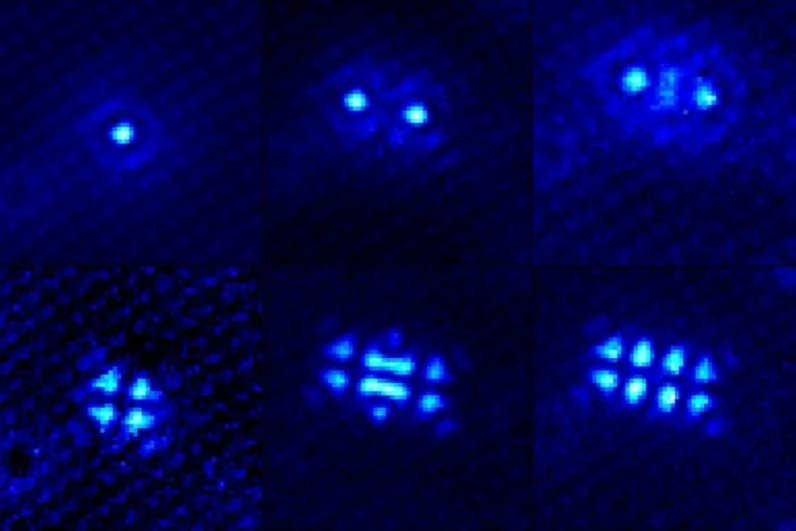
Using atomic-resolution scanning and spectroscopy, researchers identified abnormal patterns near minor atomic defects in the lattice. These patterns confirmed that electron waves were being held in place by these structural imperfections, which act as nodes for quantum interference.
The findings were published in the journal Science. The research team suggests that by manipulating atomic structures and defect distributions, it may be possible to precisely control electron behavior for future quantum computing and information processing applications.