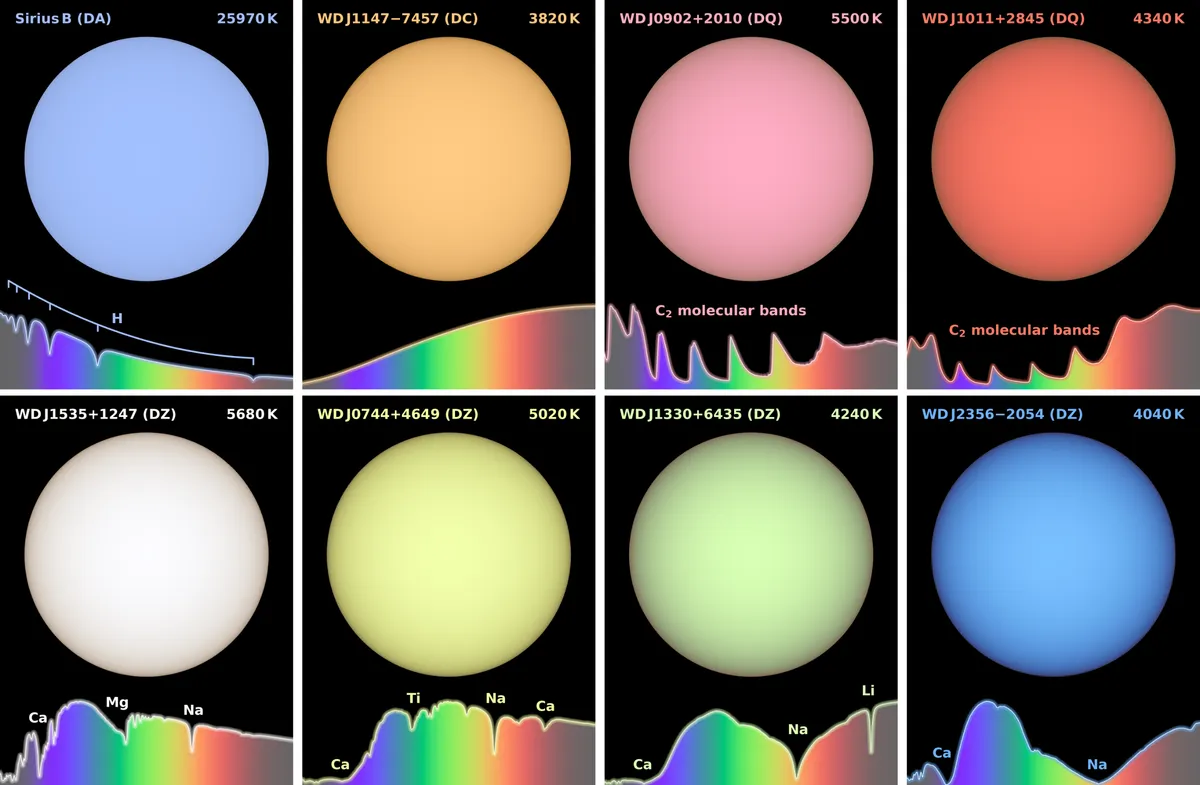
Astronomers have identified white dwarf WD J1330+6435, located 300 light-years away in the Draco constellation, as the first known star with a potential yellow-green hue. This color is not observed directly but derived from spectral data and human visual perception models.
The star's unique coloration results from the accretion of planetary debris, which enriched its atmosphere with calcium, lithium, and sodium. High atmospheric density causes sodium atoms to collide with helium, absorbing yellow, orange, and red light, while calcium absorbs violet light, shifting the peak emission to approximately 500 nanometers.
The research team, publishing in RAS Techniques and Instruments, re-analyzed existing spectral data to demonstrate that white dwarf colors depend on atmospheric composition rather than temperature alone. The star maintains a temperature of approximately 4000 degrees Celsius.
The study also highlighted white dwarf WD J1011+2845, located 48 light-years away, which appears salmon-pink due to carbon convection. While most white dwarfs remain white, the findings suggest a broader spectrum of colors, including yellow, green, cyan, pink, and purple, can exist depending on chemical makeup.