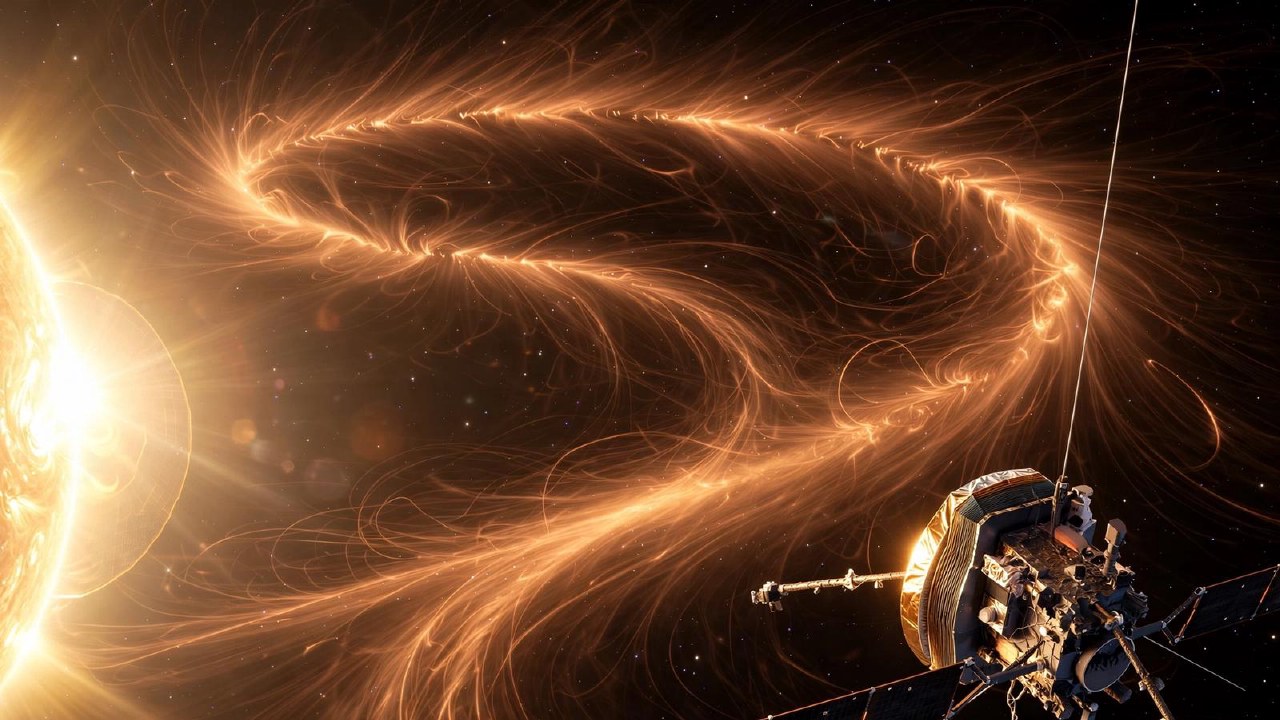
The European Solar Orbiter probe successfully passed through a magnetic switchback in the solar wind. By collecting direct measurements, researchers traced the origin of these S-shaped magnetic field structures back to the solar atmosphere. This confirms that the phenomenon is linked to the solar corona.
Data from the Solar Wind Analyzer revealed highly ionized oxygen and carbon ions within the switchback. These particles indicate that the material originated from hot coronal loops. This supports the theory of interchange reconnection, where plasma escapes into space when open and closed magnetic field lines connect.
The study also suggests that wave activity and turbulence influence the switchback after it leaves the Sun. According to co-author Stephanie Yardley, both the initial reconnection process and subsequent turbulence play roles at different stages of the structure's life cycle.
Scientists combined probe measurements with solar disk imagery and magnetic field models to map the origin of these structures. Understanding these particle emissions is essential for space weather forecasting, as charged particle streams can disrupt satellites, communication systems, and power grids on Earth.