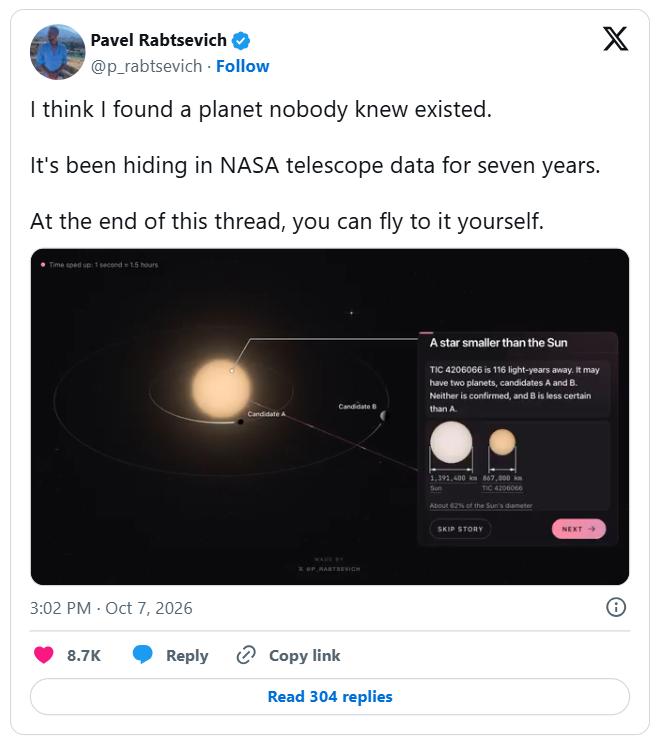
Astronomy enthusiast Pavel Rabtsevich identified a potential exoplanet candidate by analyzing NASA archival data. The focus of the study is the star TIC 4206066, which exhibits regular brightness dips lasting approximately 2 hours. Preliminary calculations suggest the candidate planet has a radius 1.4 times that of Earth and an orbital period of 3.18 days.
To validate the findings, Rabtsevich utilized Claude Code, OpenAI Codex, and the Jev tool. He identified 23 instances of brightness drops across three TESS datasets. Using Claude Code, he performed 74 verification tests, including predictive modeling on hidden data segments, which reportedly aligned with the star's observed behavior.
The hypothesis is now scheduled for verification by the TESS telescope under program number 100. From October 31 to November 26, the telescope will monitor the star's brightness at 2-minute intervals. These observations aim to confirm whether the predicted transits occur as expected, though further analysis will be required to rule out alternative astronomical phenomena.