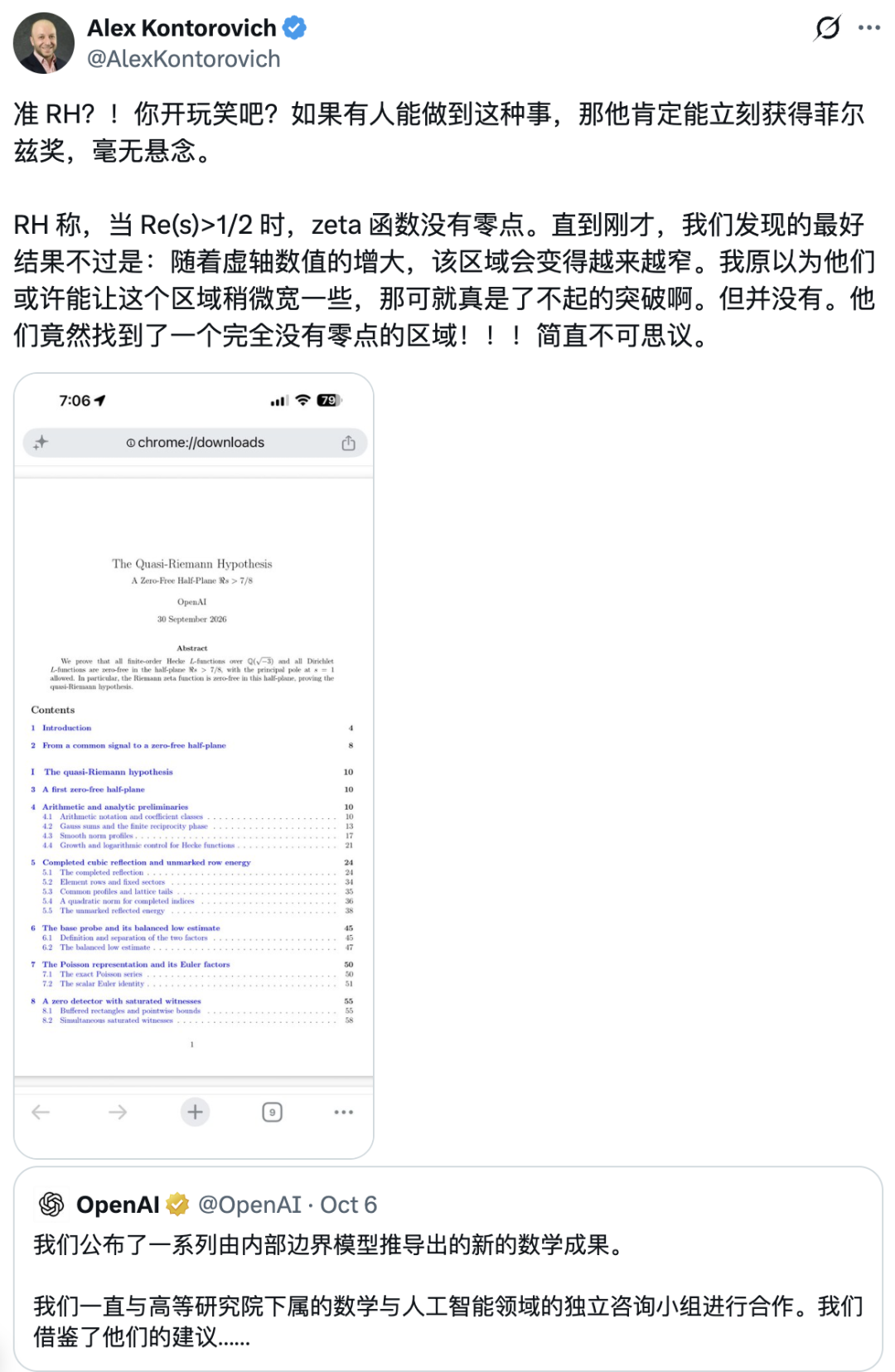
On October 6, OpenAI announced that its AI had proven a form of the quasi-Riemann hypothesis. Mathematician Hector Pasten confirmed that the result successfully eliminated Landau-Siegel zeros, marking a definitive solution to the problem rather than incremental progress. The proof was detailed in a 199-page document.
Following this, researchers Cureton and Thorner applied the AI-derived tools to finite-order Hecke L-functions. They established that these functions have no zeros to the right of the 1-1/6000 boundary. The global mathematical community subsequently refined this zero-free region boundary to 1/32, with the result verified by the AxiomProver agent using the Lean formal verification language.
On October 12, mathematicians Frei, Somos, and Widmer published a paper on the arXiv preprint platform. They utilized the new zero-free region results to provide an unconditional proof for the 2007 Ellenberg-Venkatesh conjecture regarding the l-torsion of number field class groups. This proof resolved a 19-year-old mathematical problem that previously relied on the assumption of the Generalized Riemann Hypothesis.