

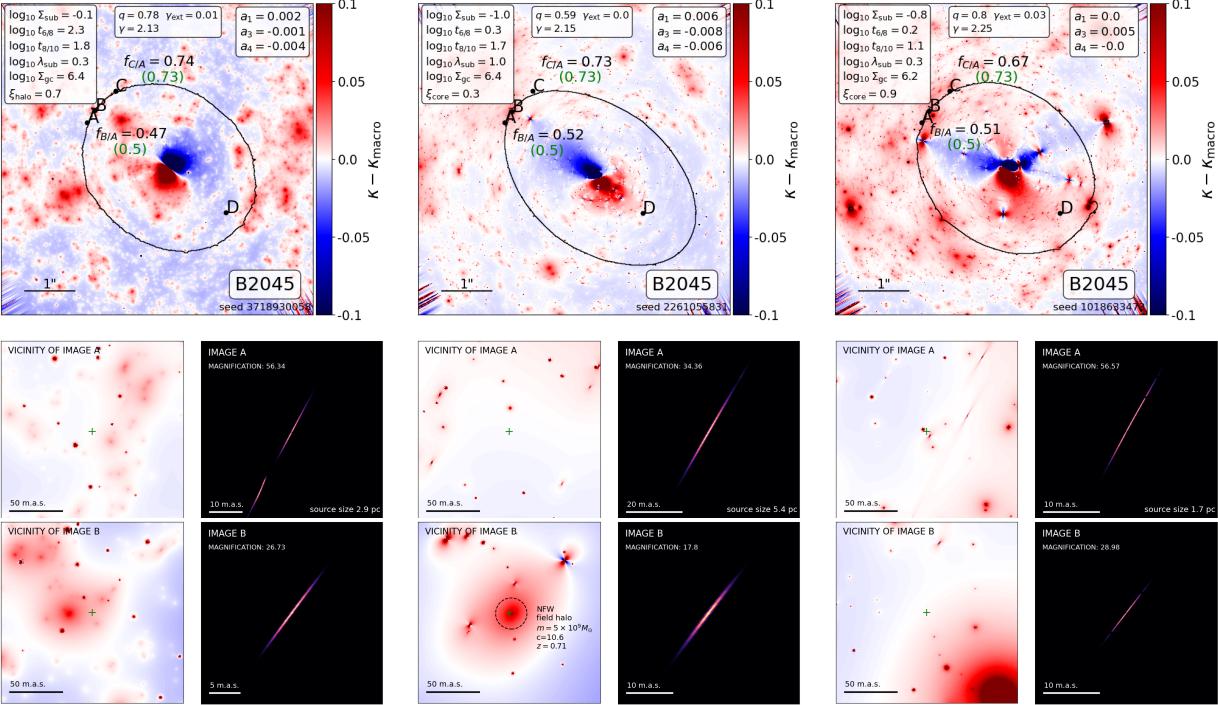
Astronomers utilized the James Webb Space Telescope to investigate the nature of dark matter by analyzing 29 distant quasars. These objects appear as four distinct images due to gravitational lensing, where galaxy mass distorts space-time. By observing brightness fluctuations in these images, researchers can detect invisible matter clusters that are otherwise impossible to observe directly.
The study compared observational data against theoretical models, specifically testing the hypothesis of self-interacting dark matter. This model suggests that dark matter clusters can undergo gravitational collapse, leading to increased central density. Such structures exert a stronger influence on the light emitted by distant quasars compared to the standard cold dark matter model.
Statistical analysis, specifically Bayesian evidence, indicates that the self-interacting model is 6 to 24 times more likely to explain the observed data than the standard model. However, researchers note that the standard model could still hold if there were significantly more small dark matter clusters and globular star clusters than current calculations predict.
The findings are currently considered a potential lead rather than a definitive discovery. Further observations and independent verification methods are required to confirm whether dark matter particles possess self-interacting properties or if the observed phenomena result from other cosmological factors.


