

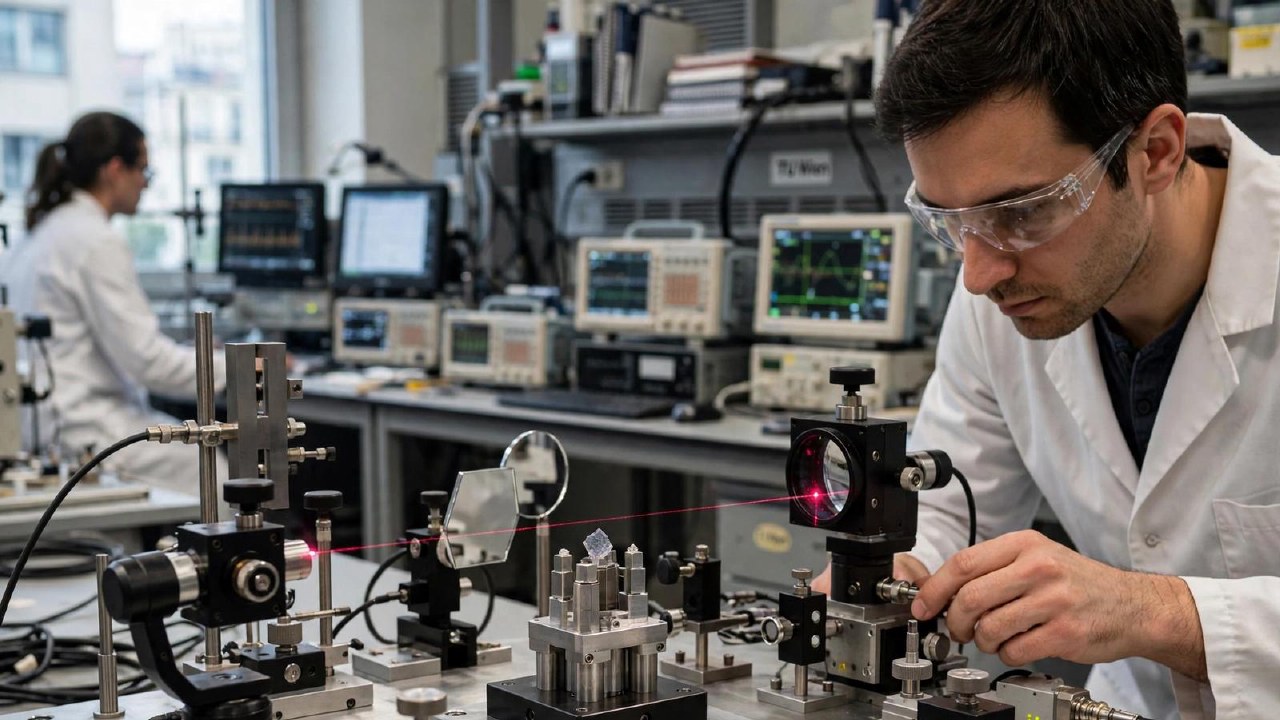
Researchers at the Vienna University of Technology (TU Wien) have developed the first self-stabilizing nuclear clock. Unlike conventional atomic clocks that rely on electronic state transitions, this device utilizes energy transitions within thorium nuclei to maintain frequency stability.
The prototype operated for over 24 hours without external intervention. Measurements indicate a relative error equivalent to 1 second per 30 million years. While this performance currently trails behind the best optical atomic clocks, it marks the first successful demonstration of independent nuclear stabilization.
The technology centers on a specialized crystal containing thorium atoms. The system automatically adjusts the laser frequency based on the absorption rate of the nuclei. If the frequency drifts, the absorption weakens, triggering an immediate correction within the setup.
Nuclear clocks offer potential advantages over electronic counterparts because nuclei are over 10,000 times smaller than atoms and are less susceptible to certain external environmental disturbances. The team plans to enhance precision by using higher-quality crystals and more powerful lasers.

