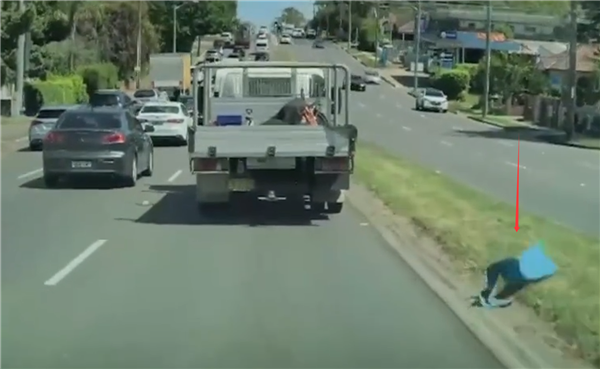
A Tesla vehicle operating with the Full Self-Driving (FSD) system was involved in a rear-end collision after performing an emergency stop. The incident occurred when a plastic bag blew into the path of the car, prompting the FSD software to trigger an immediate braking maneuver.
The vehicle was struck from behind by a truck that failed to stop in time. The Tesla owner attributed 80% of the responsibility for the accident to the FSD system and 20% to the truck driver, suggesting the latter may have been distracted.
Despite the collision, the Tesla sustained minimal damage, limited to a dented license plate and its mounting bracket. The owner noted that the low speed of the trailing truck contributed to the lack of significant structural impact on the car.
The FSD system's reaction highlights a recurring challenge for pure vision-based autonomous driving technologies. Because the system relies on cameras and neural networks to classify objects, it struggles to identify unpredictable items like blowing plastic bags, which do not match standard training models.
While humans can often distinguish between harmless debris and physical obstacles, AI systems currently lack such physical intuition. Consequently, most current driver-assistance systems prioritize safety by braking rather than driving over unidentified objects, necessitating constant driver supervision.