

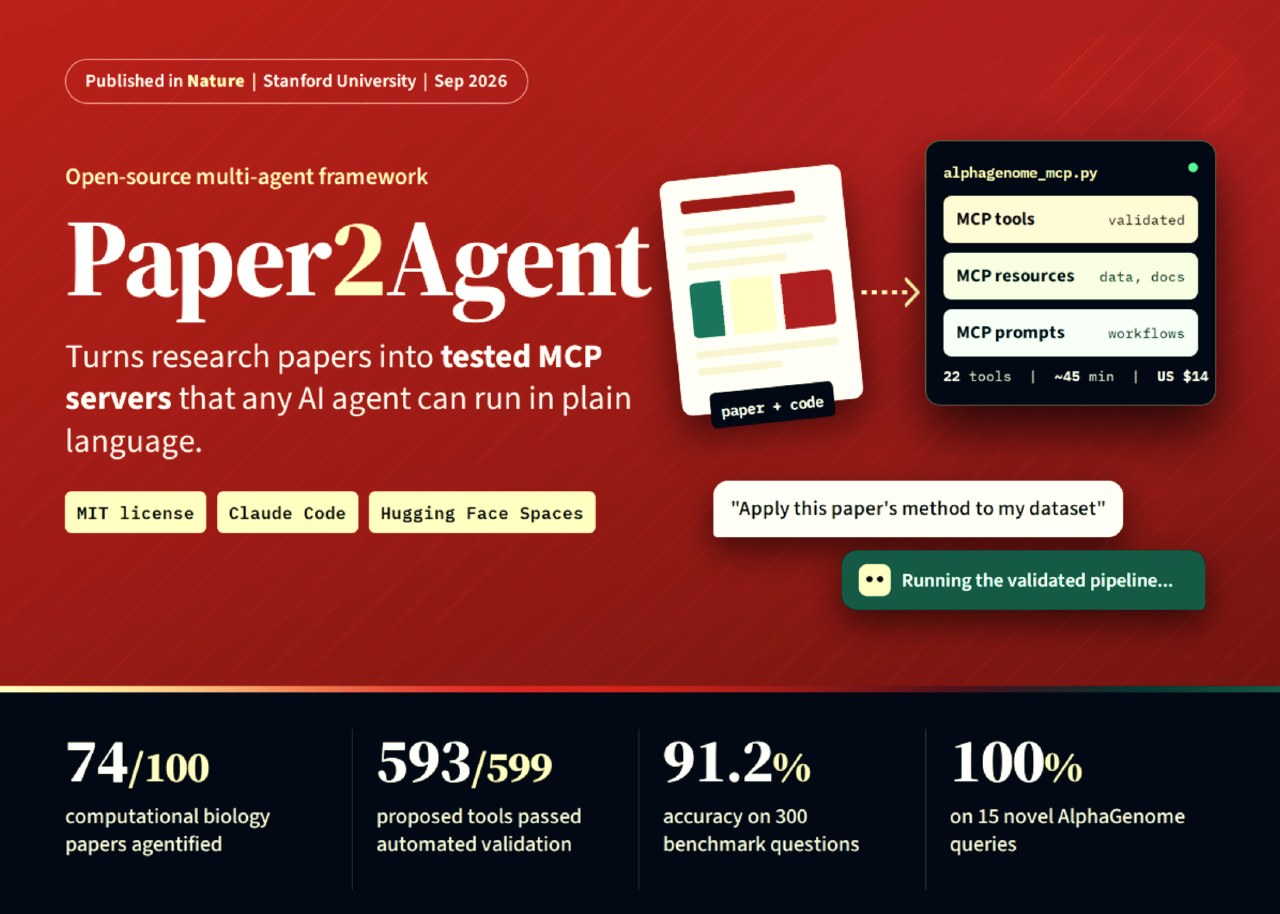
Stanford researchers introduced Paper2Agent, a framework that converts research papers into AI agents capable of reproducing results and processing new data. The system utilizes Claude Code’s SDK and Claude Sonnet 4 to create specialized sub-agents. It is available under an MIT license, with prebuilt servers for AlphaGenome, Scanpy, and TISSUE hosted on Hugging Face Spaces.
The validation process involves a strict six-step gate where tools must match expected files and numerical outputs within a 3% margin. Figures are verified using perceptual hashing with a Hamming distance under 20. The system allows up to six attempts per function, automatically excluding tools that fail to meet these criteria.
Performance tests showed the AlphaGenome agent built 22 tools in 45 minutes for $14, while the Scanpy agent created 7 tools in 45 minutes for $13. In comparative benchmarks, Paper2Agent demonstrated faster median runtimes than Claude + Repo and Biomni. The agent also successfully rejected all out-of-scope queries during testing.
Researchers demonstrated the system by connecting three agents to analyze genomic data. For an AlphaGenome study, the AI identified GPR137 as a candidate gene at a psoriasis locus. The system also proposed validation strategies, with experimental results showing a Spearman correlation of 0.613 at 8 hours and 0.630 at 48 hours of stimulation.



