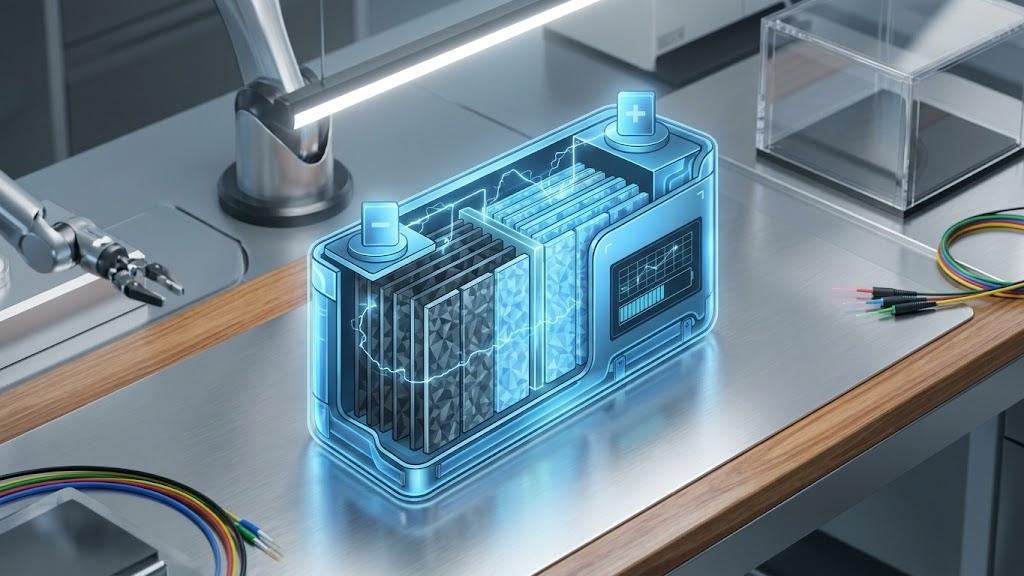
Researchers at Shanghai University have developed a new method to enhance the capacity of manganese flow batteries. By replacing the traditional manganese sulfate electrolyte with a semi-solid suspension containing manganese dioxide particles, the team achieved a 409% increase in capacity compared to standard solutions.
The new design addresses the solubility limits of traditional manganese batteries. During discharge, solid manganese dioxide converts into soluble manganese ions, allowing the system to utilize more active material. At a concentration of 4 mol/L, the system reached a volumetric capacity of 156.2 Ah/L.
The battery maintained high performance at a current density of 30 mA/cm², achieving a capacity above 151 Ah/L and an energy efficiency exceeding 71%. This current density is 30 times higher than previous results for similar semi-solid manganese dioxide systems.
Testing with a 1 mol/L suspension showed the battery could withstand 100 charge-discharge cycles. The system demonstrated a coulombic efficiency of approximately 99% and an energy efficiency of 76%. Further development is required to minimize capacity losses during operation.