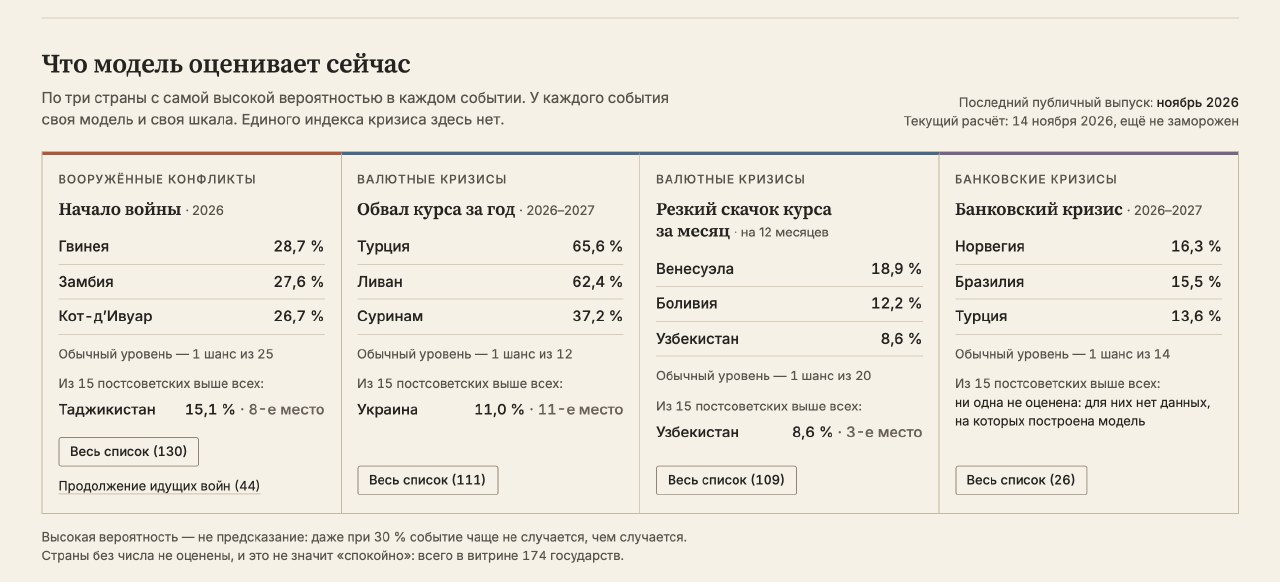
The Seldon project aims to estimate the probability of major geopolitical and economic events, including wars, currency devaluations, and banking crises. The research covers 174 countries, with a specific focus on 15 post-Soviet states. The methodology emphasizes real-time forecasting without using future data, simulating conditions where statistics for the previous year are incomplete.
The project currently provides four types of forecasts: the outbreak of war, annual devaluation, monthly exchange rate spikes, and banking crises. To ensure accuracy, the system includes 111 automated tests, 65 of which are specifically designed to detect and prevent data leakage from the future. The first snapshot of these forecasts is now available, with plans for monthly updates.
Initial research tested several hypotheses, including the impact of democracy indices, the ideology of ruling parties, and the concept of critical slowing down derived from the physics of phase transitions. According to the author, these specific hypotheses did not show significant results during blind testing. The project is currently open for external feedback and collaborative development.