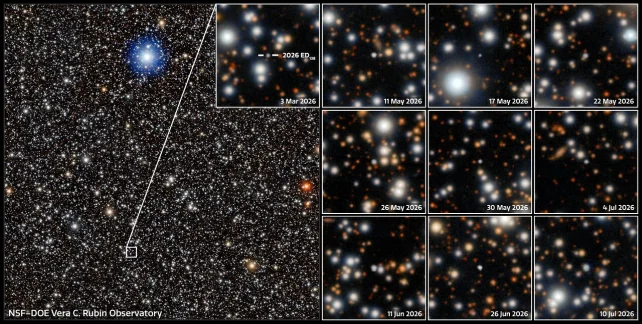
The Vera C. Rubin Observatory, funded by the National Science Foundation and the Department of Energy, has identified a new trans-Neptunian object designated 2026 ED138. Astronomer Matthew Holman from the Harvard-Smithsonian Center for Astrophysics first spotted the object on October 13 while analyzing observatory data. Subsequent research confirmed 30 observations across 20 nights between March 4 and July 11, 2026.
Archival data from the Dark Energy Camera at the Cerro Tololo Inter-American Observatory revealed that the object was captured in images as early as 2016, with additional sightings in 2017, 2018, 2019, and 2023. This decade-long record allowed researchers to map its trajectory. The object is currently located approximately 46 astronomical units from the Sun, with an orbital period of about 281 years.
The object's diameter is estimated to be between 600 and 1500 kilometers, making it a candidate for dwarf planet status. Its perihelion is 36.86 astronomical units, and its aphelion is 49.04 astronomical units, with an orbital inclination of 24.5 degrees. Researchers noted that its position near the galactic plane previously hindered detection due to the dense background of stars.
Confirmation as a dwarf planet requires evidence that the object has sufficient mass to achieve a spherical shape. Scientists plan to use infrared observations to refine size estimates. If confirmed, 2026 ED138 would join the five currently recognized dwarf planets. The Rubin Observatory, which began its ten-year survey in June 2026, aims to identify thousands of similar objects to study the evolution of the solar system.