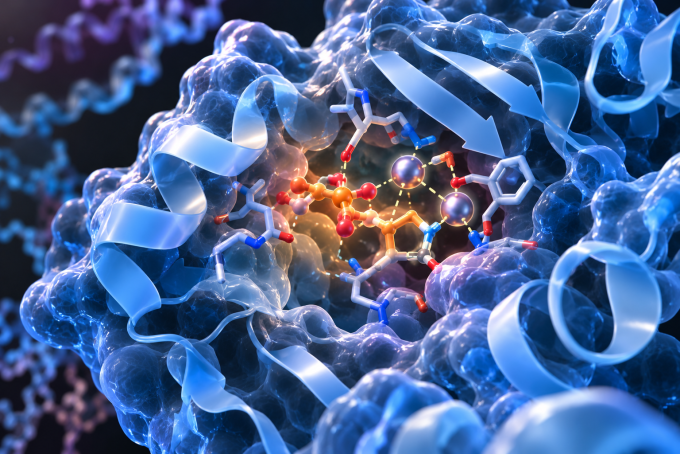
The international research team, including members from the University of Washington, the University of Oxford, and Nvidia, has unveiled the RFdiffusion3 generative AI system. This tool allows for the design of proteins and nucleic acids at the atomic level, with research findings published in the journal Science on October 16.
RFdiffusion3, which became open-source on December 3, 2025, builds upon the architecture of AlphaFold3. Unlike its predecessors, it can represent a single amino acid using up to 14 atoms, enabling direct adjustment of 3D coordinates to create new protein structures. The system also incorporates constraints such as hydrogen bond formation and specific atomic distribution.
In performance tests, RFdiffusion3 outperformed the previous RFdiffusion2 model in 37 out of 41 cases involving enzyme active site design. The new system generates protein structures approximately ten times faster than the second version. Researchers successfully validated the design of organophosphate-degrading enzymes and peptide-cleaving enzymes in real-world experiments.
The project was led by David Baker, a professor at the University of Washington and 2024 Nobel Prize laureate in Chemistry, known for his work on the RosettaFold system. The development of RFdiffusion3 marks a shift in AI-driven research from merely predicting existing protein structures to designing entirely new proteins with specific functional capabilities.