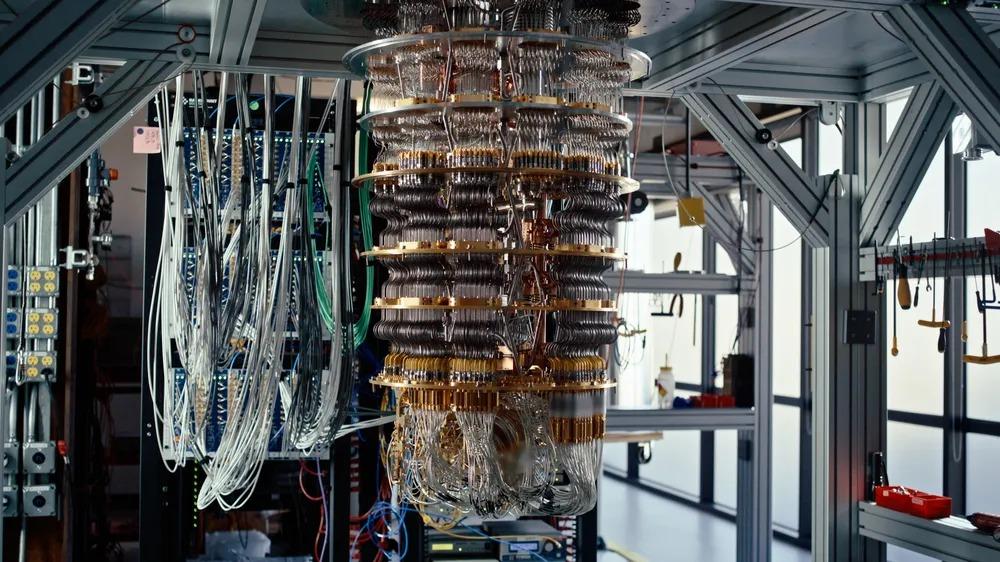
Anthropic's Claude Mythos 5 model has autonomously designed quantum computing circuits that significantly reduce operational requirements. The model operated in an automated loop, proposing designs and refining them based on verification feedback without human intervention. It optimized eight core procedures across chemistry, optimization, number theory, and numerical methods.
For elliptic curve operations, Claude developed a method for modular inverse calculation in 53 hours. By deriving new algebraic identities to reconstruct operation history, the model created a circuit that uses 17 times fewer quantum gates than previous versions, despite a 12% increase in qubit usage. This result was verified through numerical simulations and the Lean proof assistant.
In the context of the Decoded Quantum Interferometry algorithm, Claude replaced the extended Euclidean algorithm with the Berlekamp-Massey decoder. This reduced the gate count by 12 times compared to a Google design and lowered memory requirements from 665 to 19 qubits. This optimization relies on a probabilistic approach, with a failure rate of approximately one in 10,000 cases.
The model also contributed to modeling the FeMoco cluster. While energy state calculations for this system previously required 50 trillion Toffoli gates in 2017, cumulative improvements have reduced this to 340 million. The developers note that this progress is the result of long-term community efforts rather than the work of the AI alone.
Despite these advancements, the researchers emphasize that fault-tolerant quantum computers remain distant. The study focuses solely on circuit design rather than full system integration, such as error correction or hardware control. Furthermore, the method is currently limited to tasks where classical computers can efficiently verify the results.