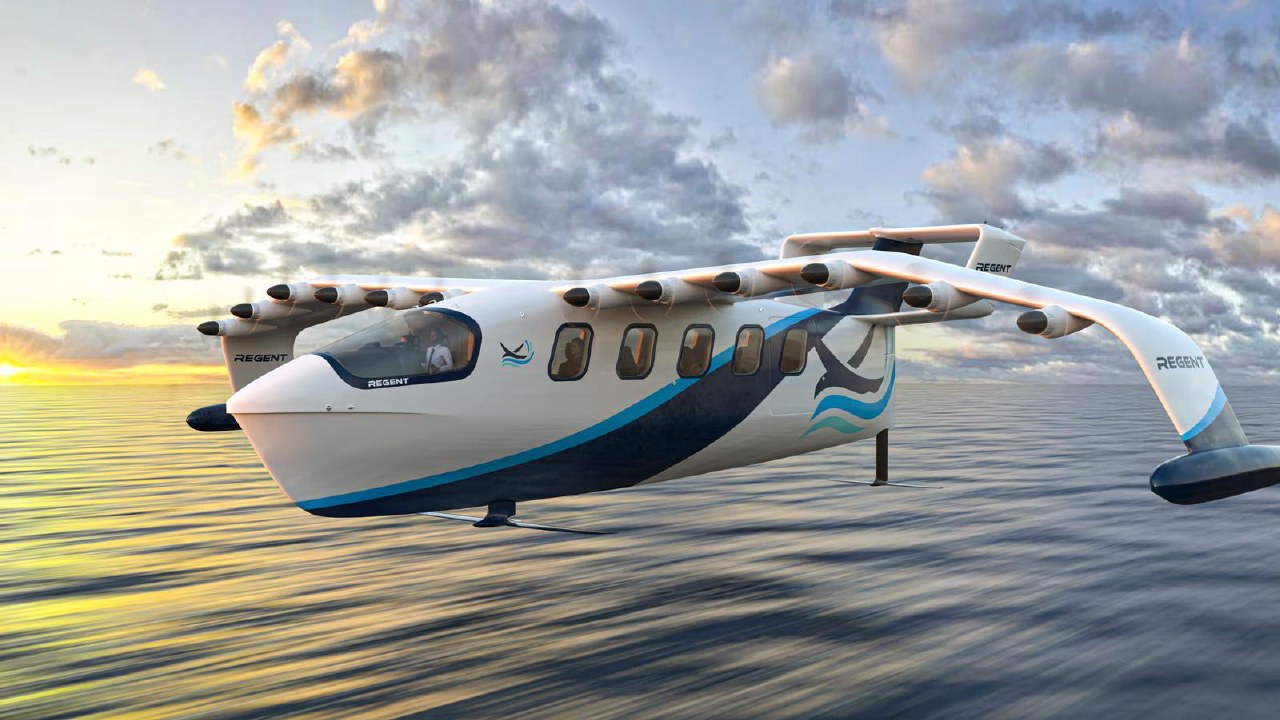
The American company Regent Craft has successfully completed the first manned own prototype of the electric wing-in-ground effect vehicle (WIG) Viceroy Seaglider. During tests in Narragansett Bay, Rhode Island, the craft rose approximately 10 meters above the water, covering 596 meters in 30 seconds with two captains on board.
The Viceroy is designed to operate in three distinct modes: as a conventional vessel, on hydrofoils, and in flight mode using the ground effect. This configuration allows the use of existing ports and docks, while the hydrofoils provide stability during acceleration to reach flight speeds.
The craft's control system is largely automated, featuring a triple-redundant digital system for stability. The operator primarily sets the direction and speed, reducing the complexity of traditional aircraft piloting. The production version will accommodate 12 passengers and two crew members.
The production model's maximum speed is approximately 290 km/h, with a range of up to 290 km. Its fully electric power plant is intended to make the vehicle quieter than traditional aviation transport. In the US, the Viceroy is legally classified as a vessel, regulated by the US Coast Guard rather than aviation authorities.
Regent Craft has already secured a significant order book. The operator The Twenty Five has ordered up to 60 Viceroy units for coastal passenger transport in the US. Additionally, the company has a $15 million contract with the US Marine Corps research division and is collaborating with the US Special Operations Command.
The military is considering the Viceroy for rapid cargo delivery, medical evacuation, and reconnaissance missions. Prior to the Viceroy, the company had already tested an unmanned WIG craft called Squire.