

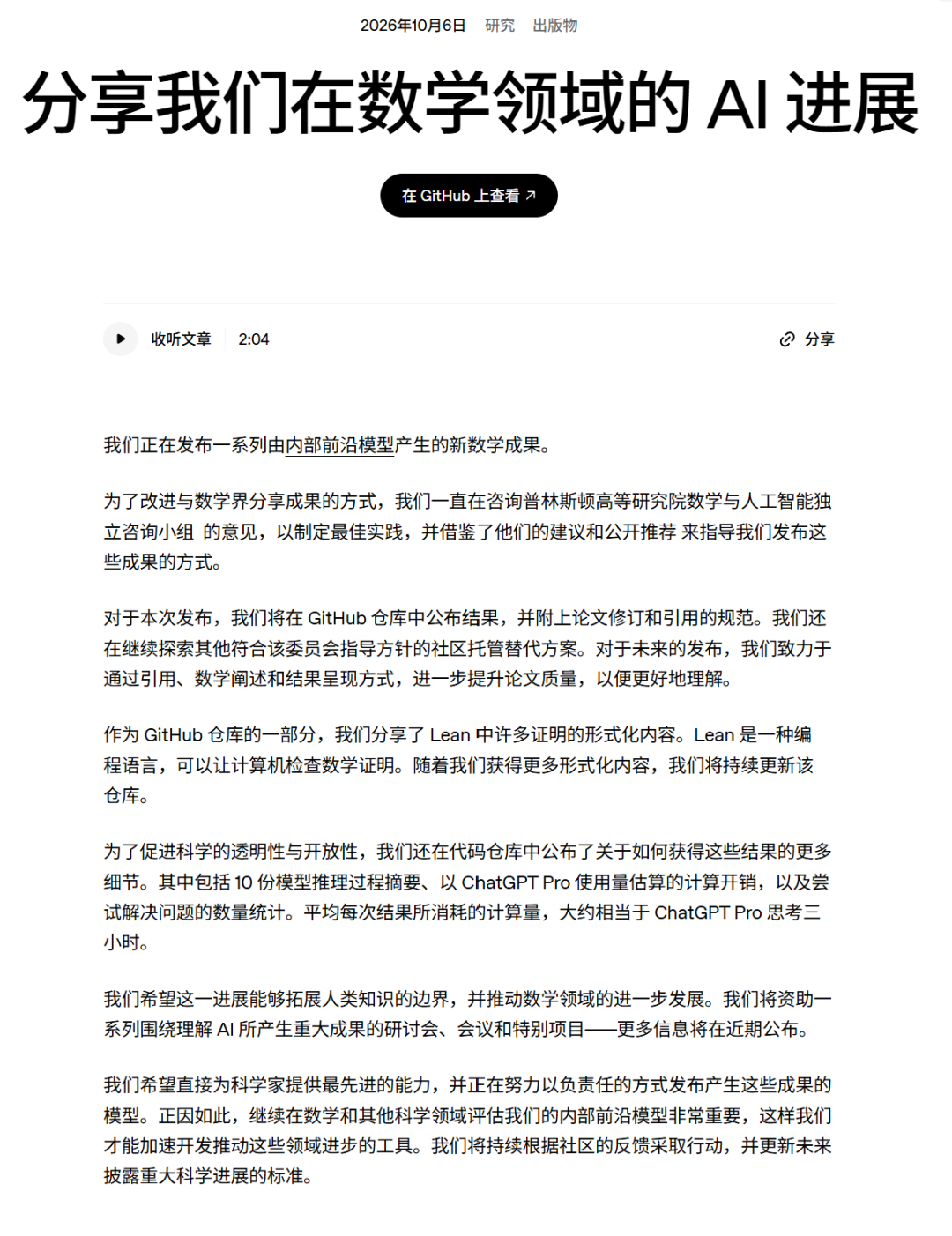
OpenAI has released 722 mathematical manuscripts covering 372 long-standing mathematical problems. The company utilized an unreleased internal model to generate these proofs, with most tasks requiring an average of 3 hours of computing power.
Among the findings is a proof related to the quasi-Riemann hypothesis, demonstrating that all Dirichlet L-functions lack zeros in the half-plane where the real part is greater than 7/8. This work underwent manual review and refinement by the research team.
The collection includes a proof for the NP-hardness of the Basic-SDP threshold without relying on the Unique Games Conjecture (UGC). This result establishes a theoretical limit for polynomial-time approximation algorithms based solely on the P versus NP assumption.
Additionally, the model addressed the Hodge conjecture for abelian varieties with complex multiplication and proved the symmetric Mahler conjecture across all dimensions. These findings were published alongside formal verification via Lean.
OpenAI previously convened a private meeting in August with 40 mathematicians to discuss the implications of AI potentially surpassing human capabilities in pure mathematics. The release of these results has sparked significant debate within the academic community regarding the future of professional mathematics.


