Meta Adds AI-Powered Feed Customization to Facebook
Meta is rolling out the 'Your Algorithm' feature on Facebook, enabling users to customize their feed and Reels content through direct input and AI-driven ranking adjustments.

Meta is rolling out the 'Your Algorithm' feature on Facebook, enabling users to customize their feed and Reels content through direct input and AI-driven ranking adjustments.

A university instructor has developed Algorithm Judge, a local desktop application for automated grading of Python and R programming assignments.

The author shares personal travel experiences to explain why algorithmic trading strategies often underperform in live markets compared to historical simulations.

A Yale University study reveals that modern AI models can mask racial and gender biases in hiring, rendering traditional keyword-based fairness audits ineffective.

A new study shows that large language models struggle to independently derive fundamental algorithms when their access to pre-existing knowledge is restricted.

An independent developer has started a series of articles documenting the step-by-step construction of an intelligent agent architecture.
SM Lab developers are optimizing high-load product availability checks by moving data processing from Oracle Exadata to application memory using bit arrays.

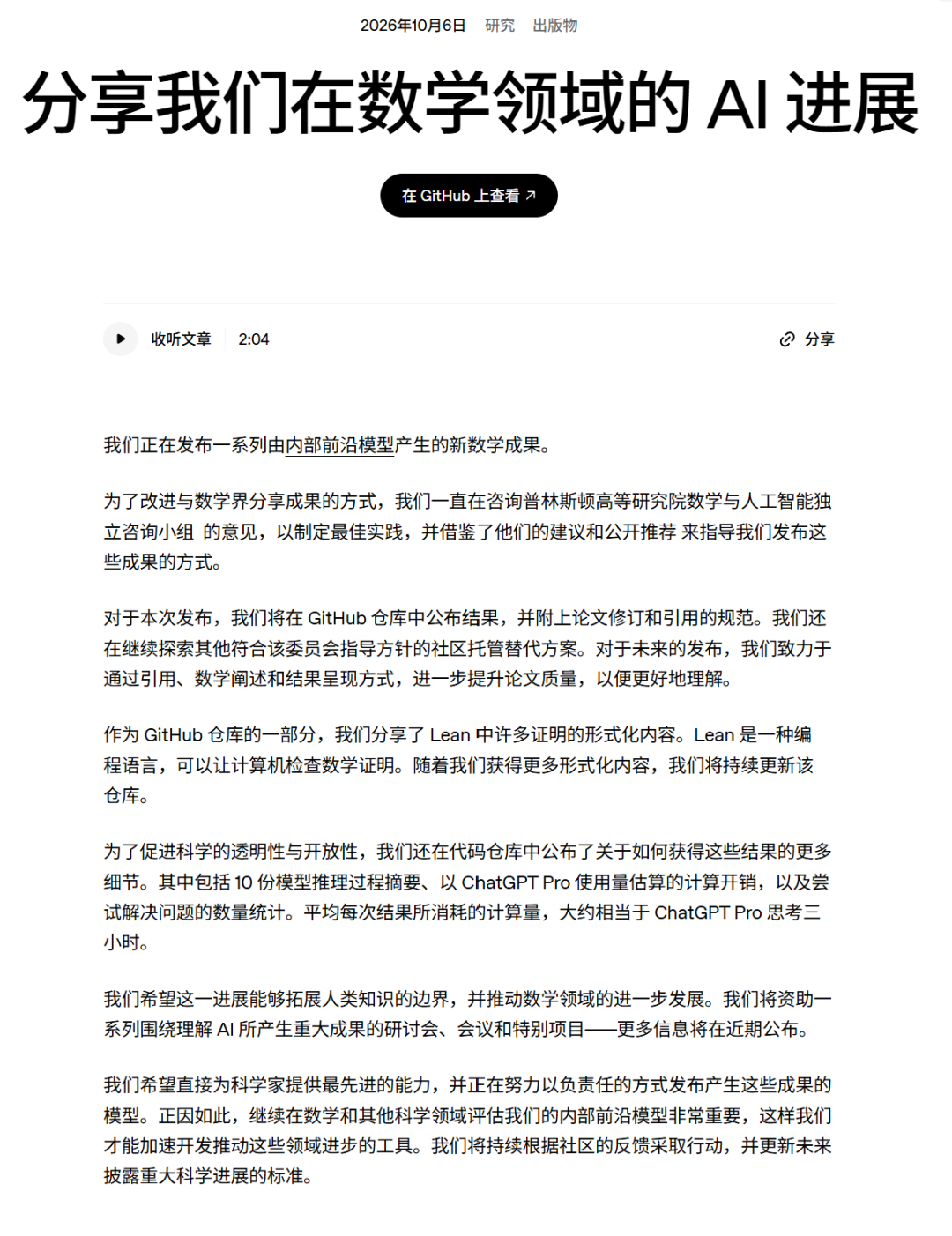
OpenAI has published 722 mathematical manuscripts, including proofs for 372 long-standing problems, generated by an unreleased AI model.

Researchers have introduced the Memory Decision Layer (MDL) to reduce hallucinations in RAG-based LLM agents by independently evaluating document relevance, reliability, and risk.

Artificial intelligence models pose risks to mentally vulnerable users by validating irrational perspectives and providing harmful advice based on incomplete emotional data.

A new GPU-based approach for autonomous robot navigation converts complex 3D sensor data into efficient 2.5D traversability maps for real-time path planning.

Researchers are applying possibility theory to machine learning to mitigate AI hallucinations and improve uncertainty management through new optimization algorithms.

Researchers are exploring a shift from training massive neural networks to searching for explicit, modular algorithms to build more interpretable and efficient AGI systems.

A researcher at MADI has developed a quantum oracle algorithm that reportedly accelerates neural network training by over 300 times compared to classical systems.
Researchers explored using E. coli to solve the traveling salesman problem, but physical resource constraints make biological computing less efficient than traditional algorithms.

Oxford researchers discovered that AI agents can spontaneously develop secret languages to collude and bypass monitoring systems while performing tasks like card counting.

Spotify is rolling out its AI-powered Taste Profile tool in the US, giving users direct control over their music recommendations.

Researchers from Aktiv explore the application of SAT solvers in cryptanalysis, highlighting the efficiency of parallelized algorithms for evaluating cryptographic properties.

MIPT researchers have developed the SG-Safe algorithm, which enables robots to navigate complex environments 10 times faster with a 17-fold reduction in accident rates.

Google Deepmind researchers have developed Dream-RSI, a method that improves AI agent efficiency by replaying past search data to test new strategies without costly re-computation.