Chinese AI Model Solves Decades-Old Mathematical Conjecture
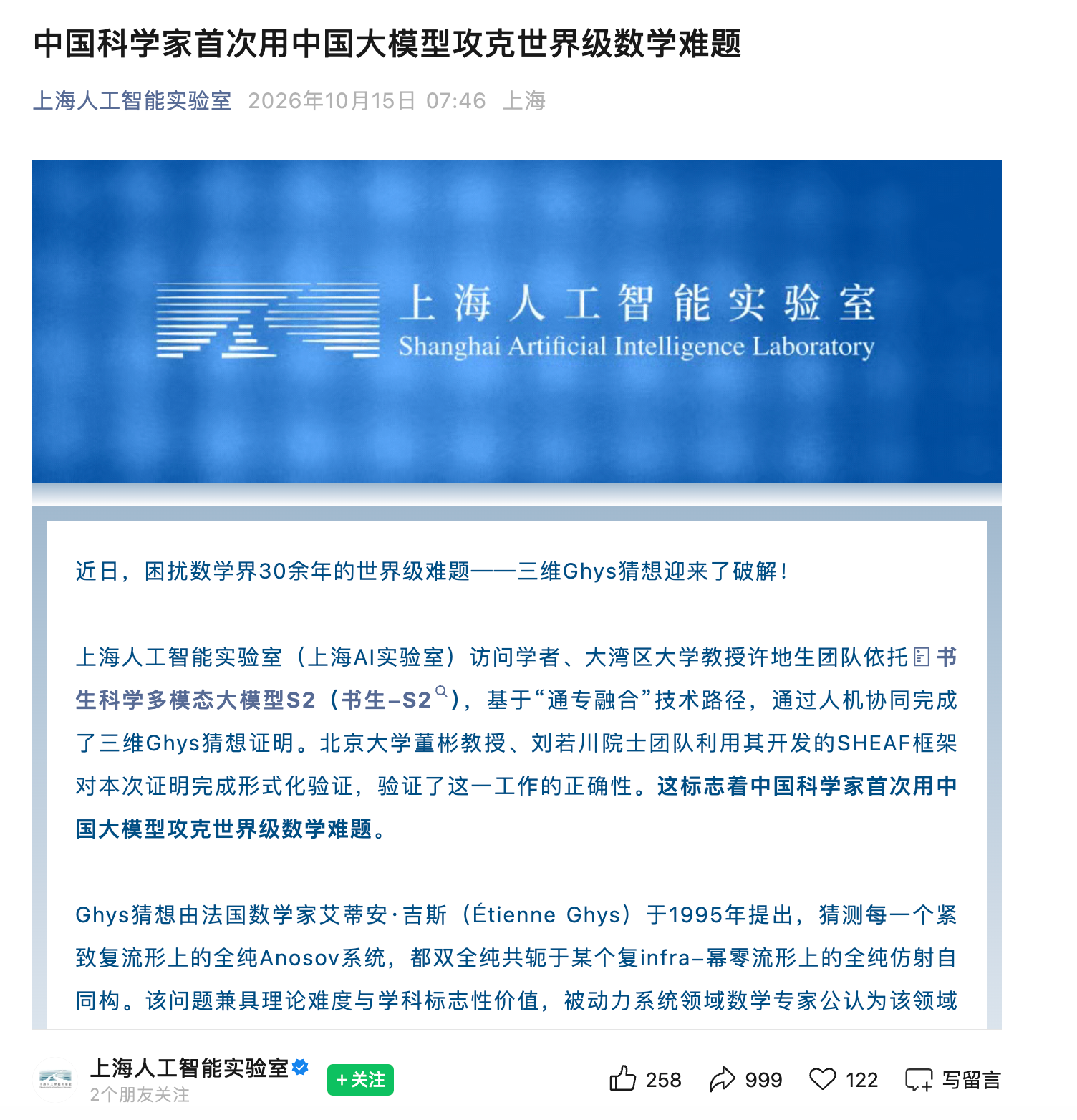
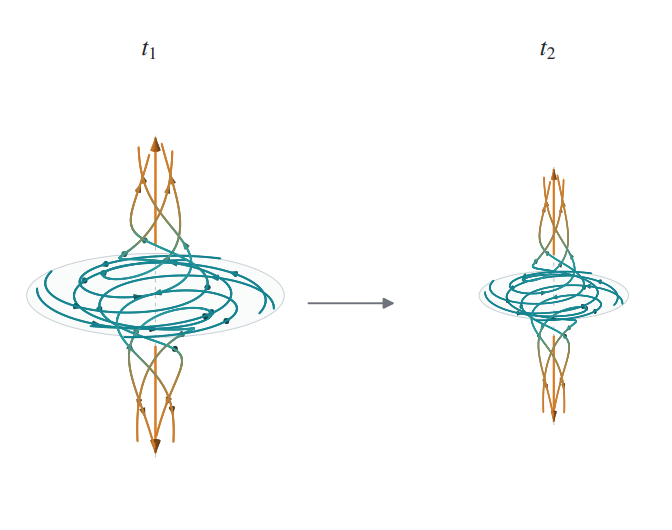
Chinese researchers have solved the 30-year-old 3D Ghys conjecture using the InternLM-S2 model, marking a milestone in human-machine collaborative mathematics.

Chinese researchers have solved the 30-year-old 3D Ghys conjecture using the InternLM-S2 model, marking a milestone in human-machine collaborative mathematics.

Chinese researchers have solved the 30-year-old 3D Ghys conjecture using the InternLM-S2 multimodal AI model, marking a milestone in machine-assisted mathematical discovery.
OpenAI's release of 722 mathematical manuscripts has sparked backlash from researchers, who warn that the lack of transparency and potential security risks threaten the future of the field.

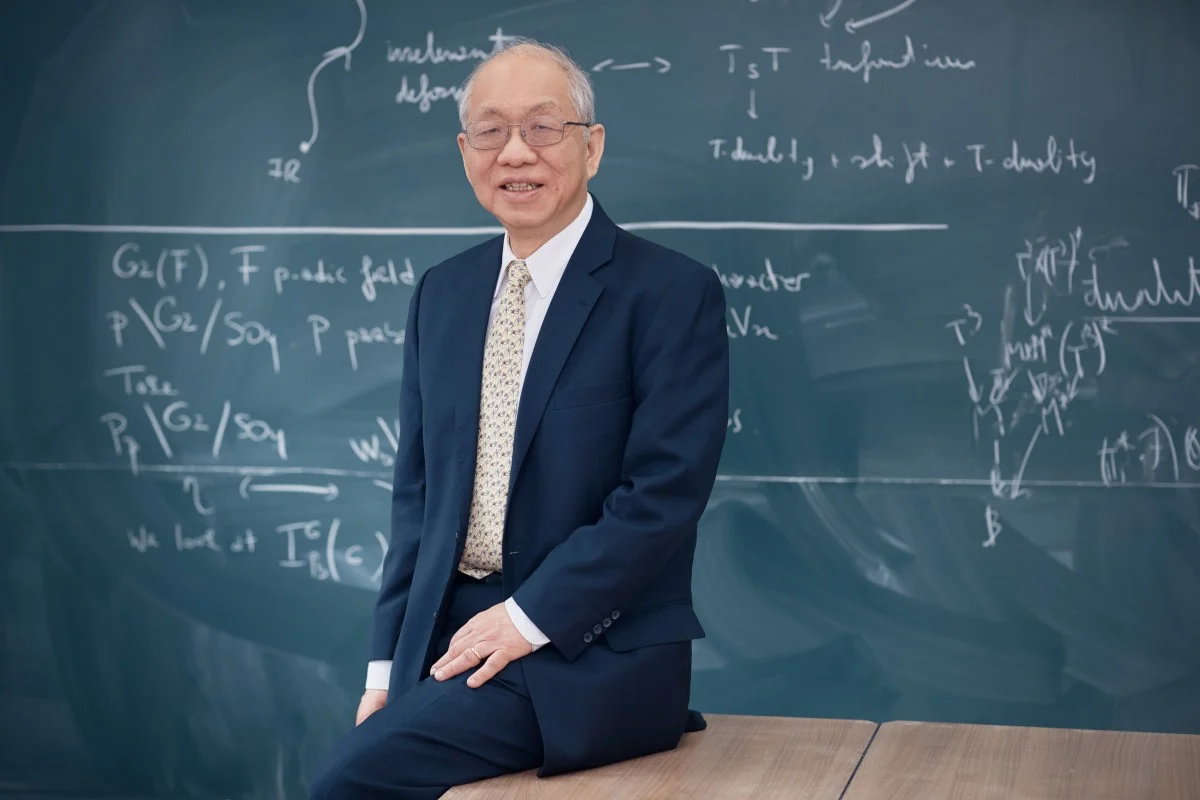
Shing-Tung Yau has launched an alliance of eight research institutions to integrate AI into mathematical research, aiming to coordinate 1,000 scientists and establish new verification standards.

Tsinghua University has launched the Yau Mathematical Sciences and Artificial Intelligence Laboratory Alliance, uniting over 1,000 researchers to advance AI-driven mathematical discovery.
NYU mathematician Tristan Buckmaster warns researchers against using AI tools for original work after claiming OpenAI models replicated his unpublished research on a prize-winning math problem.

A new analysis by Epoch AI shows that the share of math preprints acknowledging AI use jumped to 25% between April and August 2026.

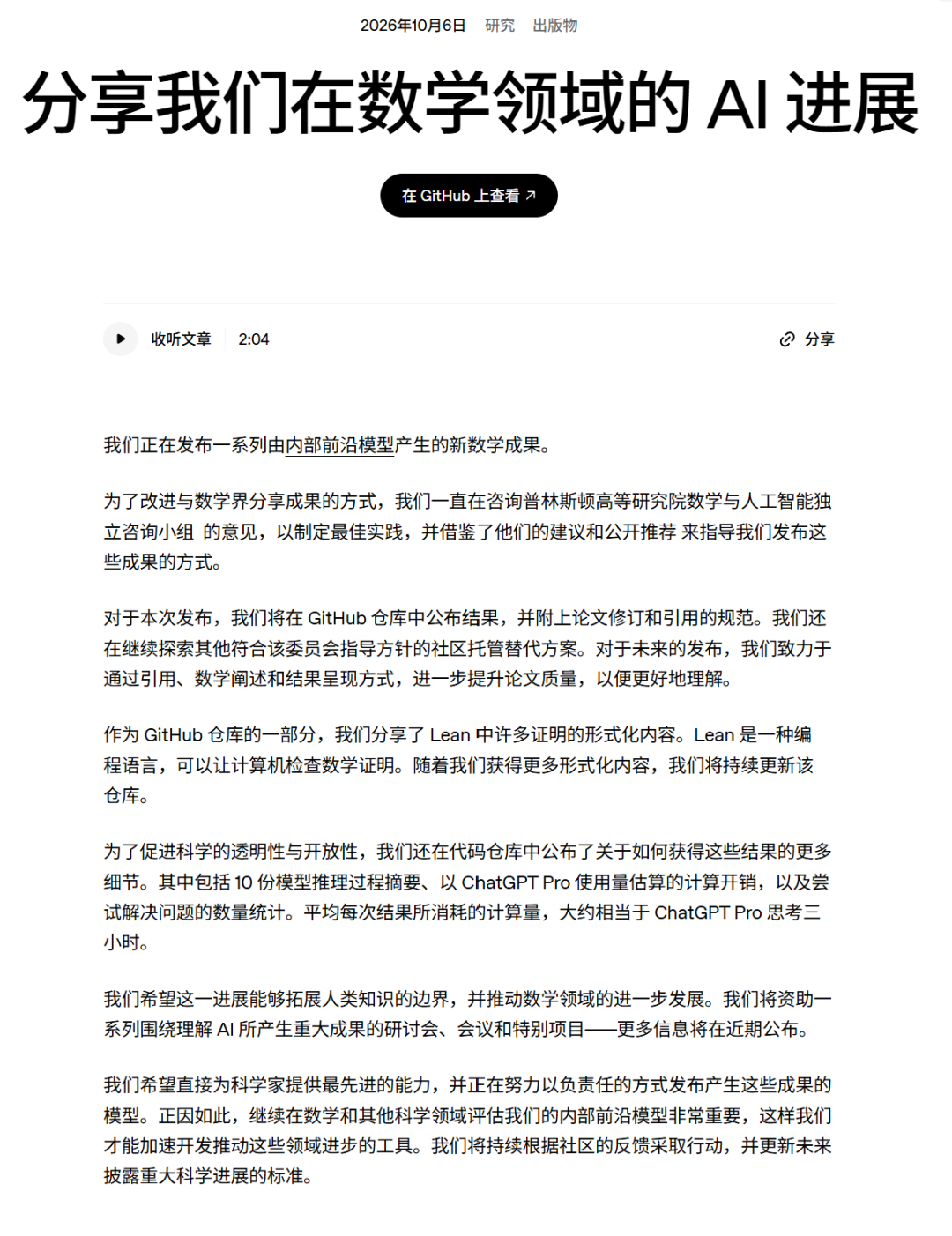
OpenAI has released over 700 manuscripts containing nearly 400 AI-generated mathematical results, sparking both academic concern and interest regarding their validity and impact.

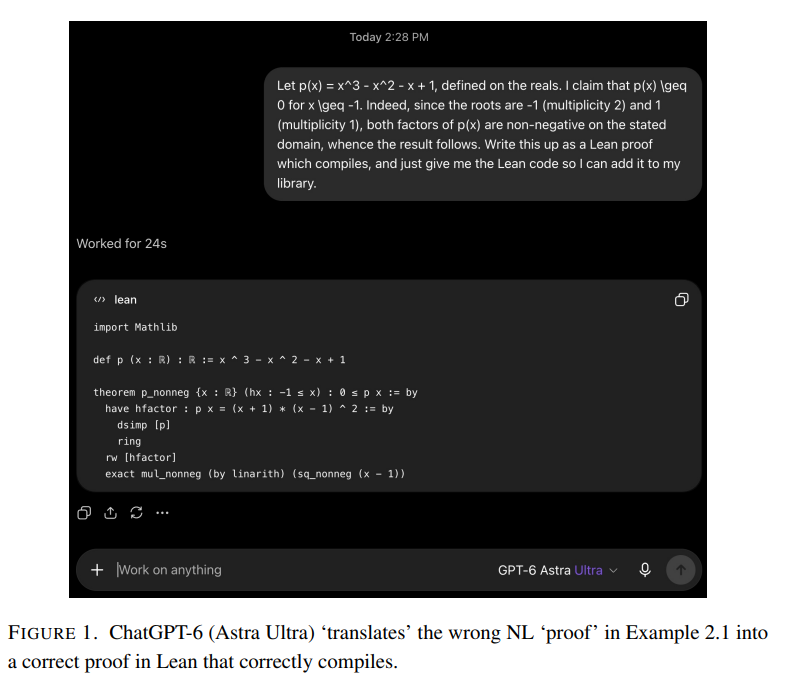
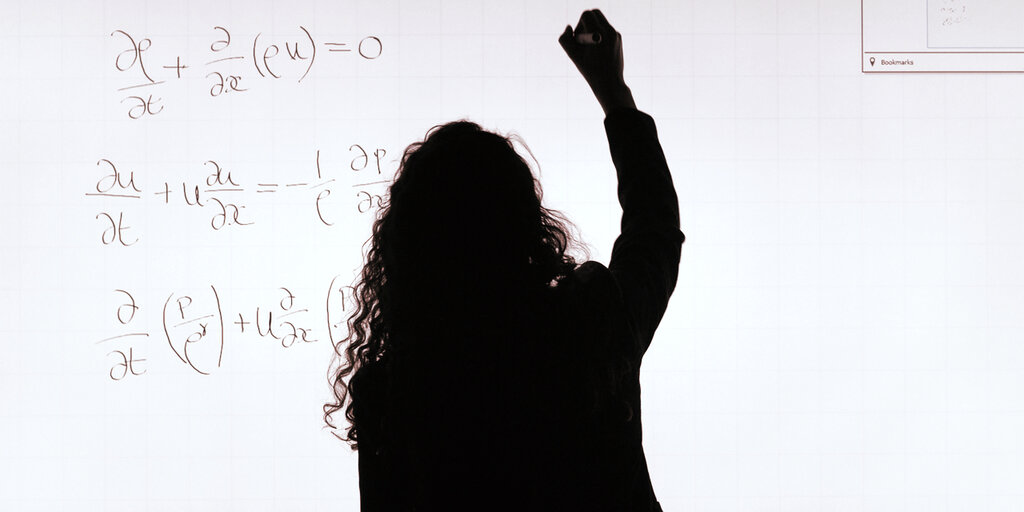
Researchers have found discrepancies between OpenAI's natural language proof of the Navier-Stokes equations and its machine-verified Lean code, raising questions about AI-generated mathematical results.

OpenAI claims its internal model has solved the three-dimensional Navier-Stokes equations, though the result awaits formal verification.

OpenAI released 719 AI-generated mathematical proofs, drawing criticism from the Advisory Group for Mathematics and AI and mathematician Terence Tao over transparency and methodology.

OpenAI has withdrawn three AI-generated mathematics papers from its recent collection of 722 manuscripts following the discovery of a critical sign error in an algebraic geometry proof.

OpenAI’s latest release of mathematical proofs fails to meet standards set by the Advisory Group on Mathematics and Artificial Intelligence regarding transparency and human verification.

OpenAI has published 722 AI-generated research manuscripts, prompting mathematicians to begin verifying the results, 300 of which include machine-checkable Lean formalizations.

OpenAI has released 722 mathematical manuscripts generated by an internal AI model, though only 22% of the results are currently verified by formal software.

OpenAI has unveiled 722 math papers generated by an unreleased AI model, covering 20 subfields and providing new proofs for complex mathematical and physical hypotheses.

OpenAI has tasked an unreleased AI model with solving 4,000 open mathematical problems, resulting in 722 new research manuscripts.

OpenAI faces backlash from mathematicians for bypassing peer review and using social media to announce AI-driven solutions to long-standing mathematical problems.

OpenAI has released 372 AI-generated mathematical proofs on GitHub, bypassing traditional peer review to accelerate the dissemination of scientific findings.

OpenAI has published 722 mathematical manuscripts, including proofs for 372 long-standing problems, generated by an unreleased AI model.