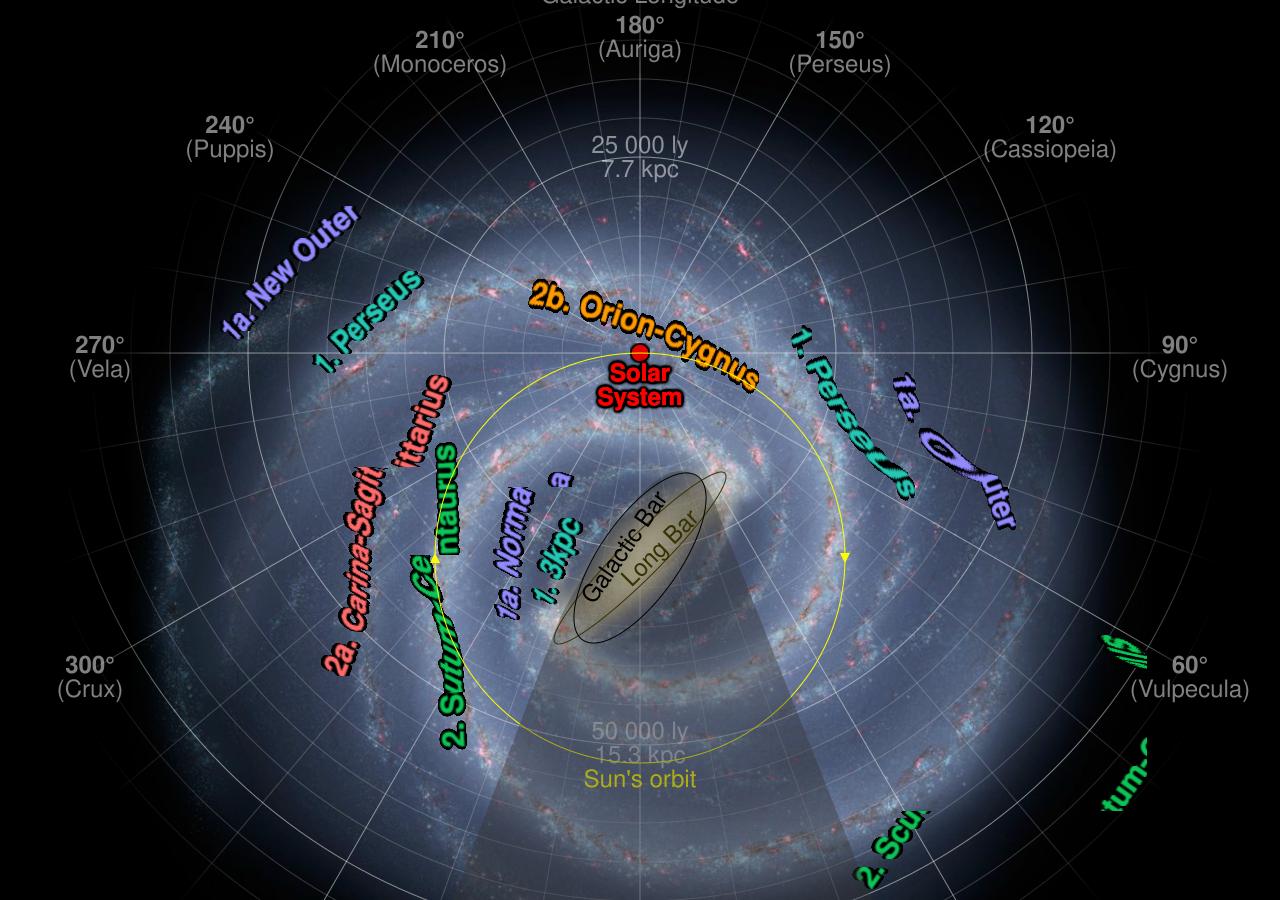
Astronomers have questioned the existence of a segment of the Norma spiral arm in the Milky Way. New research suggests that the massive star-forming regions previously used to map this arm may actually be located along a shock wave at the edge of the galaxy's central stellar bar.
The study compared observations of cosmic masers with three-dimensional hydrodynamic models. The data indicates that these masers, which are compact sources of intense radio emission, align with a dense dust structure formed by gas compression at the leading edge of the central bar rather than a spiral arm.
This interpretation suggests that star formation in the Milky Way's central bar is more active than previously modeled. The identified star-forming regions are less than 1 million years old, indicating they remain close to their parent gas clouds.
The researchers updated the parameters of the central bar, estimating its semi-major axis at 4.3 ± 0.2 kiloparsecs and its semi-minor axis at 2.3 ± 0.2 kiloparsecs. The bar's rotation speed is calculated to be no more than 40 km/s per kiloparsec, suggesting a longer and slower-rotating structure.