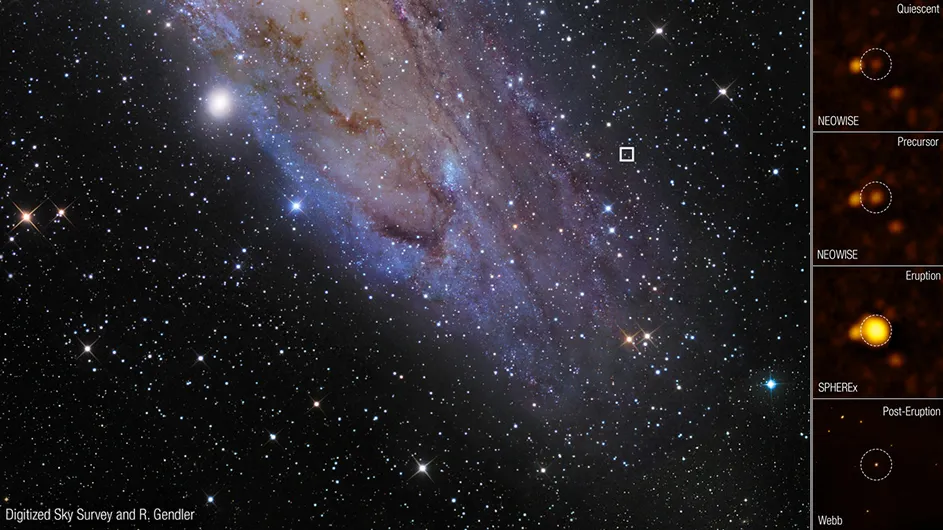
A team led by Columbia University astrophysicist Viraj Karambelkar observed the binary star system AT 2025abao, documenting the process of a star spiraling into its giant companion. The study, published in Nature, tracks the evolution of the system from 1989 through the final eruption in late 2025.
Observations from the WINTER infrared telescope and NASA’s NEOWISE mission revealed that the giant star had been brightening for seven years. Before the final event, the giant was approximately 350 times the width of the Sun, while its smaller companion was estimated at 0.7 solar masses.
Between 2018 and early 2025, the giant star brightened two- to three-fold in visible light. In July 2025, NASA’s SPHEREx telescope recorded the giant expanding to 860 times the width of the Sun. By October 2025, the system brightened 100-fold in 25 days, reaching a peak luminosity of 1.5 million Suns.
The final eruption, classified as a luminous red nova, resulted from the companion crashing into the giant's core. Analysis suggests that the companion merged with the core rather than surviving in a tight orbit. The event ejected a tenth of the giant's envelope at high speeds, creating conditions that may form hourglass-shaped nebulae.
Researchers plan to monitor the system for years or decades as dust clears to confirm the merger. Future observations using the Vera Rubin Observatory and the Nancy Grace Roman Space Telescope are expected to identify similar events in approximately 100 galaxies within 50 million light-years.