

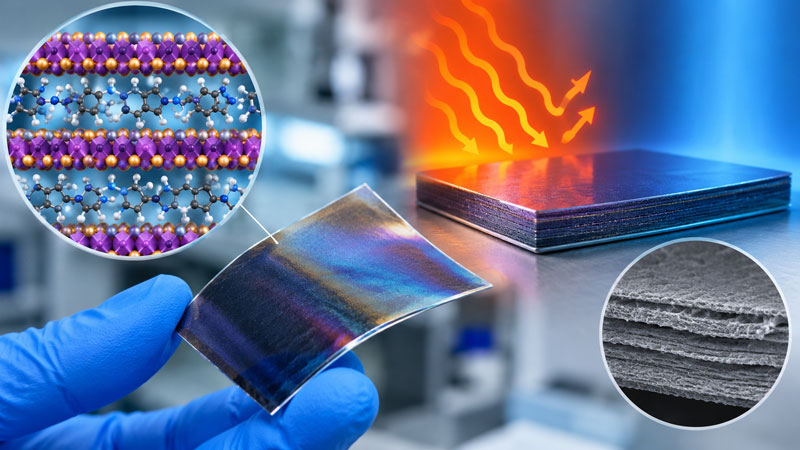
Researchers at North Carolina State University have developed a dense, non-porous film made from a two-dimensional hybrid organic-inorganic perovskite. This material combines low thermal conductivity with high mechanical stiffness, properties that are typically mutually exclusive in conventional insulators.
The film, composed of lead-based azobenzene-ethylammonium iodide, achieves a thermal conductivity of approximately 0.04 W/(m·K) at room temperature. Its elastic modulus is 7.7 GPa, which significantly exceeds the mechanical strength of standard polymers, foams, and aerogels used for thermal insulation.
The material's performance is attributed to molecular engineering of the perovskite structure, where researchers replaced carbon chains with benzene fragments. This modification effectively suppresses phonon transport while maintaining a rigid crystal lattice capable of bearing mechanical loads.
Compared to silicone, which has a thermal conductivity of about 0.2 W/(m·K), the new film provides five times better thermal insulation. Furthermore, the researchers estimate the material is 700 to 10,000 times stiffer than silicone, offering a solid alternative to porous insulators.
The production process utilizes a spin-coating method, allowing for scalable manufacturing of thin thermal insulation layers. Potential applications for this material include aerospace equipment, kitchen appliances, and various electronic devices where mechanical durability is required.

