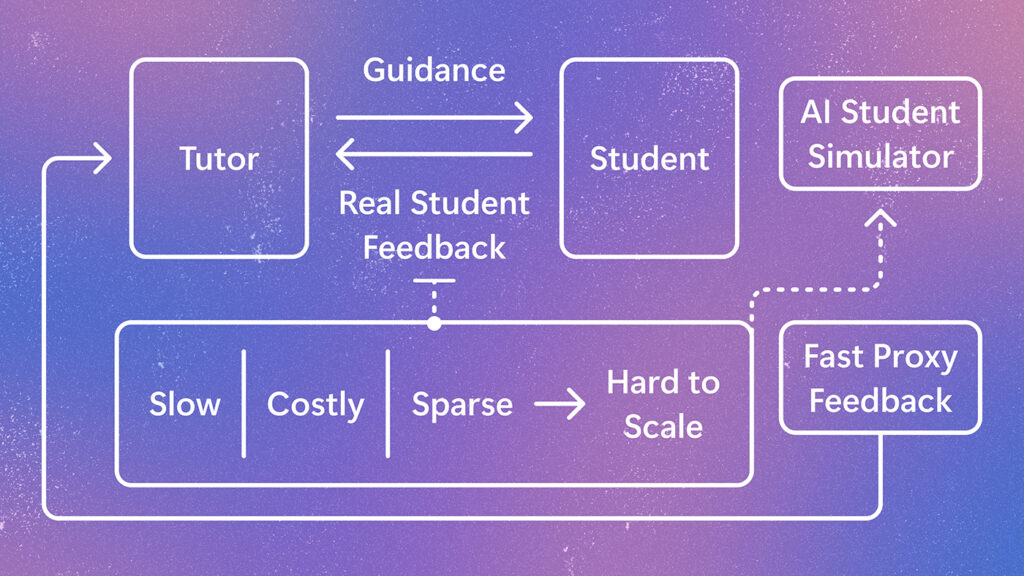
Microsoft Research introduced StudentSim, a system designed to simulate student behavior for AI tutoring tools. The project aims to address the challenge of evaluating educational AI without relying on large-scale human trials, which are often costly and time-consuming.
The system creates personalized AI student simulators using anonymized learning records. It operates in two stages: first, it learns common response patterns and error types from large datasets, then it adapts to individual student records. The model evaluates performance based on behavioral fidelity and instructional responsiveness.
The research covers three domains: chess, English writing, and mathematics. The team also released the StudentSimEval benchmark. In chess, StudentSim achieved a behavioral fidelity score of 0.5150 and an instructional responsiveness score of 0.9067, outperforming GPT-5.4 and the Maia2 model.
In reinforcement learning experiments for AI chess tutors, models trained with StudentSim feedback reached a 90.5% accuracy rate. This compares to 75.7% for baselines without reinforcement learning and 71.6% for those using GPT-5.4 feedback. Microsoft notes that StudentSim is a research tool, not a classroom product.