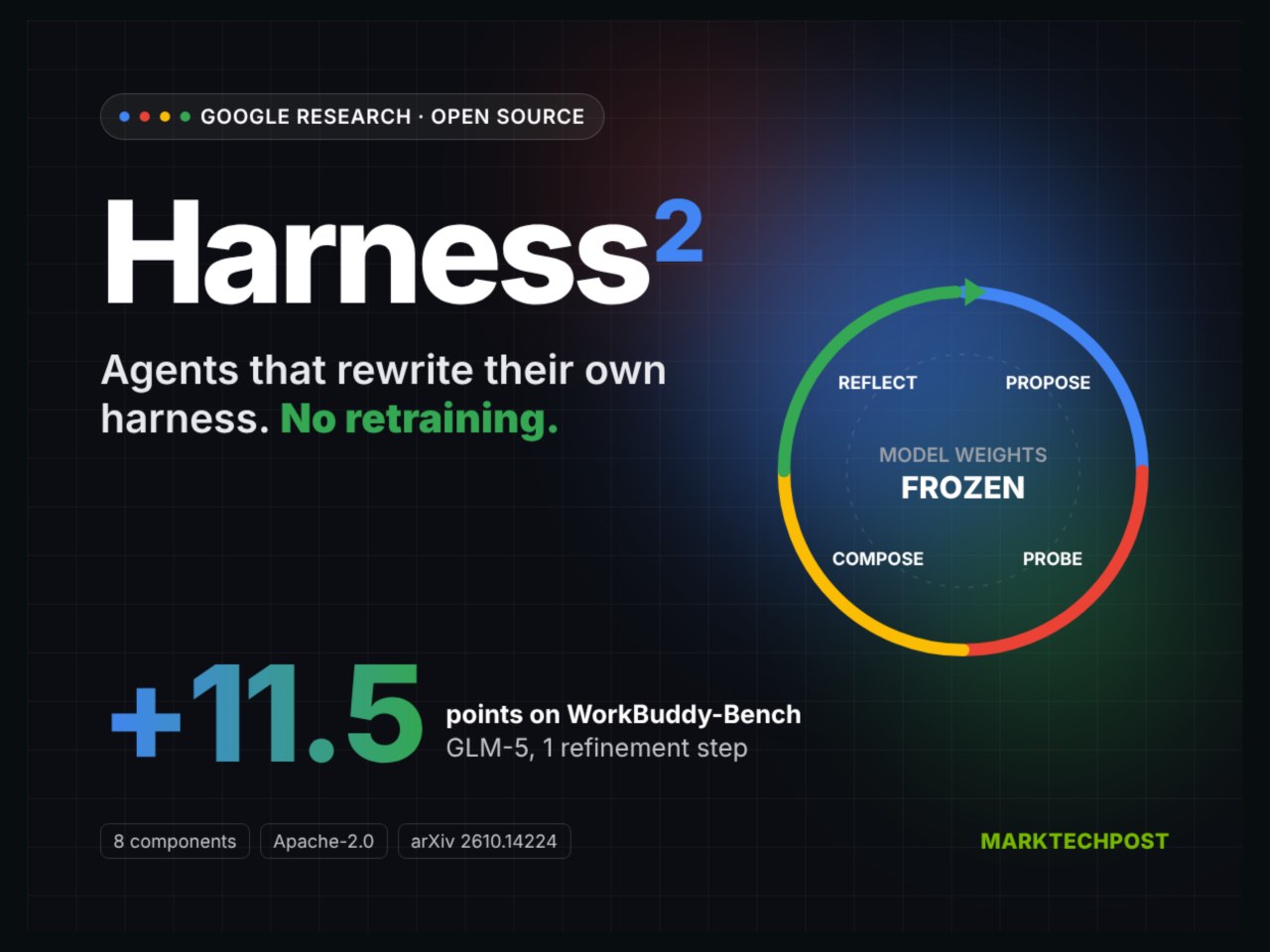
Google Research has released Harness2, an open-source framework designed to optimize agent systems during deployment. The tool focuses on refining components such as prompts, tools, memory, and orchestration without modifying the underlying model weights. It is specifically built for open-world environments where tasks are unseen and lack external verification.
The framework utilizes a budget parameter k to scale search operations. It supports parallel mode, which probes k invariant and k domain candidates to create k compositions, and sequential mode, which chains k refinement steps. The architecture extends previous agentic harness engineering by adding one additional component to the existing seven-file structure.
Researchers evaluated the framework using WorkBuddy-Bench, JobBench, and Harvey’s LAB. Testing involved Gemini 3.5 Flash and GLM-5 executors, with Claude Opus 4.8 serving as the default editor. Results showed that weaker executors experienced the most significant performance gains, with GLM-5 outperforming base Gemini 3.5 Flash on WorkBuddy-Bench after a single step.
In parallel recursion tests at k=5, Gemini under OpenCode reached a score of 80.8 on WorkBuddy-Bench. Furthermore, the framework reduced the number of steps required per task in three out of four configurations, with Gemini under OpenCode decreasing from 25.4 to 21.9 steps. The project is available for Linux environments using Python 3.12 and uv.