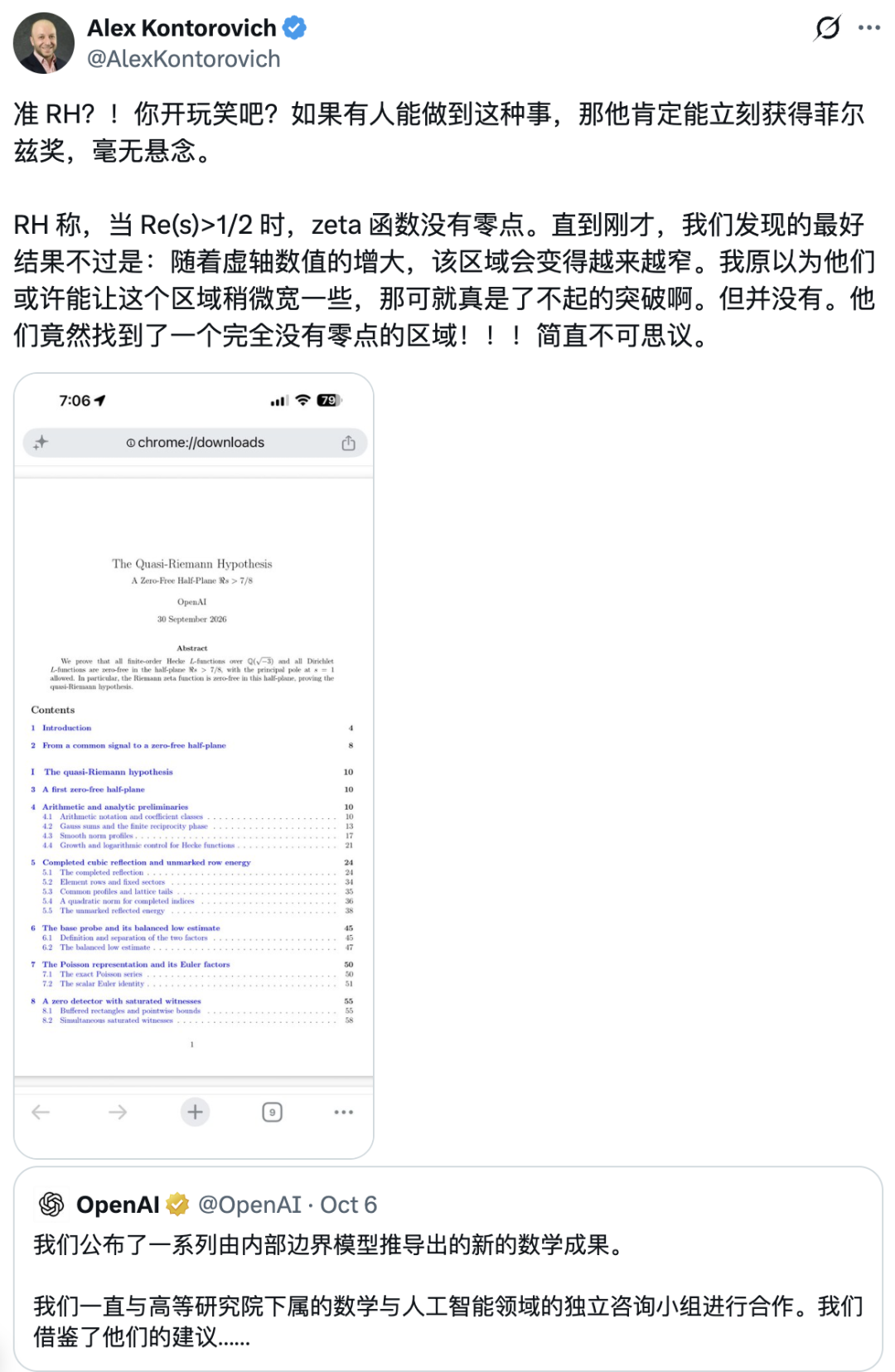
In early September, OpenAI released a 166-page document proposing a solution to the Navier-Stokes problem. The company stated the proof utilized methods developed by mathematicians Diego Cordoba and Luis Martinez-Zoroa. However, experts, including Gonzalo Cao-Labora from EPFL, argue that the approach differs significantly from the cited work and shares only superficial similarities.
The proof is written in Lean, a formal verification language. The Clay Mathematics Institute is currently reviewing the submission. Prior to publication, mathematician Tristan Buckmaster alleged that OpenAI relied on research he conducted with Levent Alpoge of Anthropic. OpenAI rejected these claims, stating it did not use Buckmaster's data. Camillo De Lellis noted that verifying such claims is difficult due to the nature of language models.
In early October, OpenAI published approximately 400 additional results on GitHub. This format drew criticism from the mathematics community. To develop the potential solution, OpenAI utilized about 10,000 model instances running for roughly 88 hours, processing 130 billion tokens. Researcher Noam Brown stated that the specific contribution of this agent swarm remains unknown.
Brown estimates that the multi-agent setup accounts for less than 10 percent of the project's success. He suggests that the base model's ability to perform parallel, long-term tasks is the primary factor. Systematic testing of such large-scale systems is currently cost-prohibitive, making it difficult to determine the performance difference between using 1,000 versus 10,000 agents.