

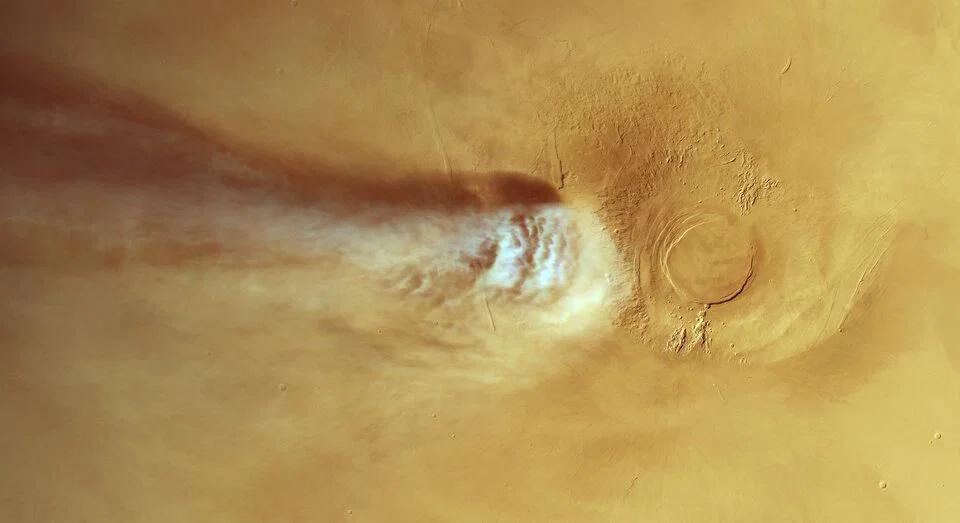
A massive water-ice cloud, known as the Arsia Mons Elongated Cloud (AMEC), forms regularly over the Arsia Mons volcano on Mars. Stretching up to 1,800 kilometers, the cloud appears in the early morning, persists for several hours, and dissipates during the day. The phenomenon was first discovered in 2018.
Researchers identified that the cloud forms through homogeneous nucleation, a theoretical process where water vapor turns directly into ice crystals without dust particles or condensation nuclei. This process requires extreme supersaturation of water vapor, which occurs due to the 19-kilometer-high volcano acting as an aerodynamic barrier.
As winds push moist air up the volcano, temperatures drop by 30 degrees Celsius within 10 minutes, triggering spontaneous ice crystallization. This discovery confirms that Martian humidity can reach levels previously thought impossible, requiring physics beyond standard atmospheric models.
The findings were supported by data from the European Space Agency's Mars Express mission, which has monitored the cloud for years. Scientists note that while the current model is not perfectly precise, the inclusion of homogeneous nucleation is essential to replicating the observed behavior of the cloud.



