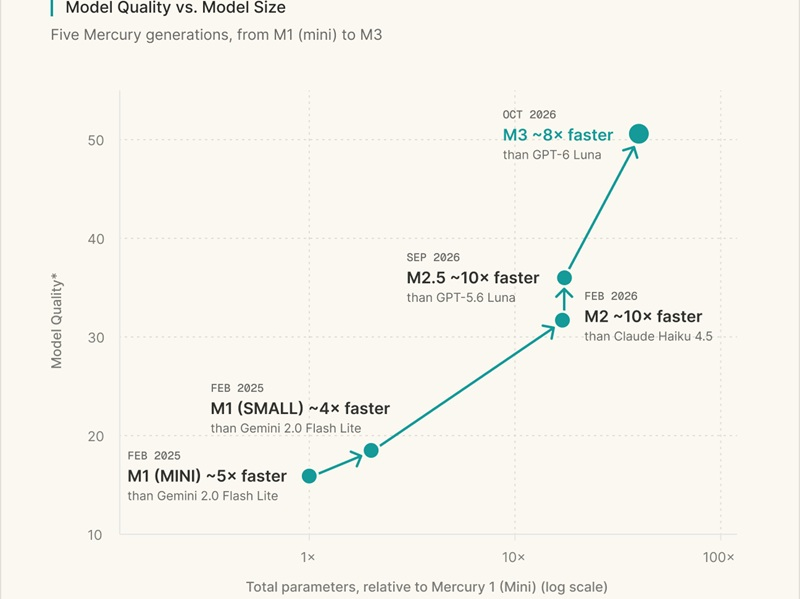
Inception, a company based in Redwood City, has unveiled its new diffusion-based large language model, Mercury 3. The model is 40 times larger than its predecessor, Mercury 1, yet maintains a high processing speed exceeding 1000 tokens per second.
Unlike traditional autoregressive models that generate text sequentially, Mercury 3 uses a diffusion approach to produce multiple tokens simultaneously. This architecture allows the model to combine high performance with low latency, offering a context window of 1 million tokens.
Internal testing indicates that Mercury 3 outperforms competitors such as GPT-6 Luna, Claude Haiku 5.5, and GLM-5.3 Flash in various metrics while operating 4 to 8 times faster. CEO Stefano Ermon noted that responses are generated almost instantly.
The model is the fourth iteration in the series since the launch of Mercury 1 in June 2025. It is now available via Inception API, Baseten, OpenRouter, and Vercel, featuring compatibility with the OpenAI API to simplify developer integration.
Pricing for Mercury 3 is set at $0.2 per million input tokens and $0.7 per million output tokens. During the launch phase, Inception has halved these rates to $0.1 and $0.35, respectively.