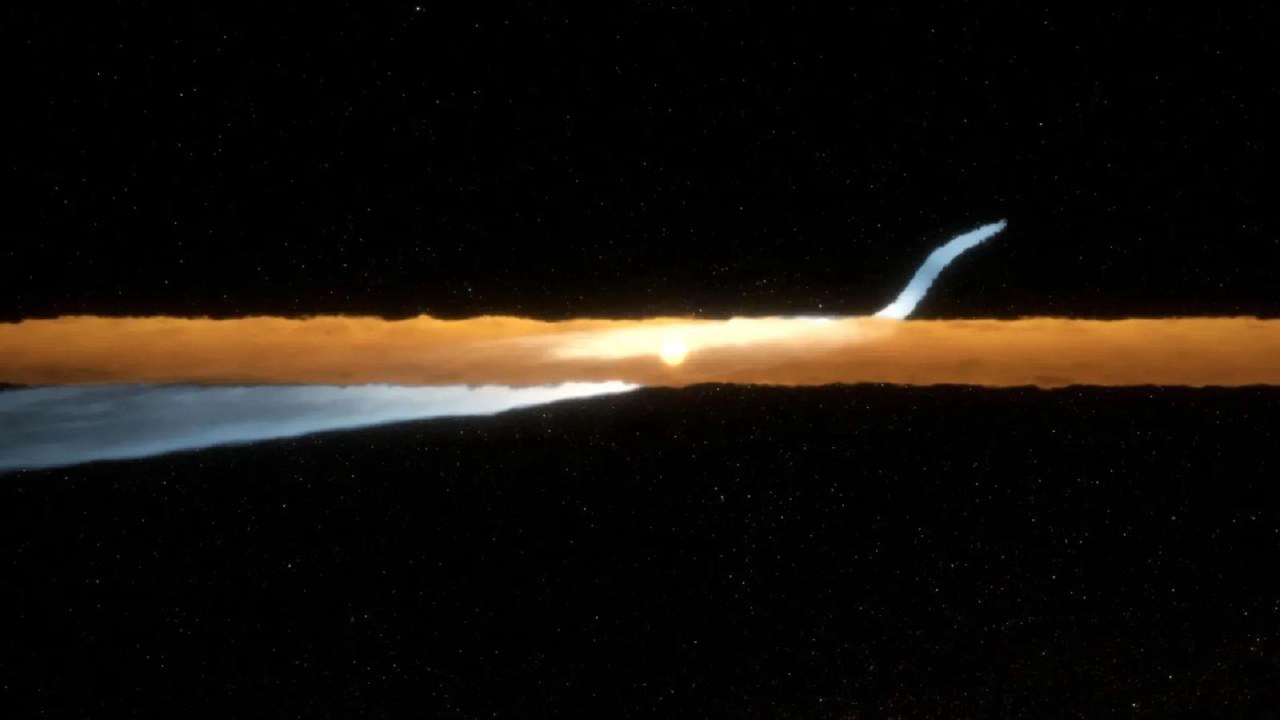
The Hubble Space Telescope has captured new images of a massive dust structure in the Beta Pictoris system, located 63 light-years from Earth. Previously, this feature, known as the Cat’s Tail, was only observable in the infrared spectrum via the James Webb Space Telescope.
The structure extends approximately 1,000 astronomical units, or 150 billion kilometers. Researchers led by Arin Avsar from the University of Arizona combined infrared and optical data to map the tail in three dimensions, revealing that it extends primarily to the side of the star rather than behind it.
The tail likely consists of carbon-rich dust particles. Scientists hypothesize that the structure formed following collisions between objects comparable in size to Pluto. These impacts released significant amounts of dust and heated carbon-rich material, which later cooled into porous particles.
Beyond the tail, astronomers identified a curvature in the dust halo surrounding Beta Pictoris. This distortion is attributed to the gravitational influence of at least three known planets within the system. Beta Pictoris is a young star system, estimated to be 23 million years old.