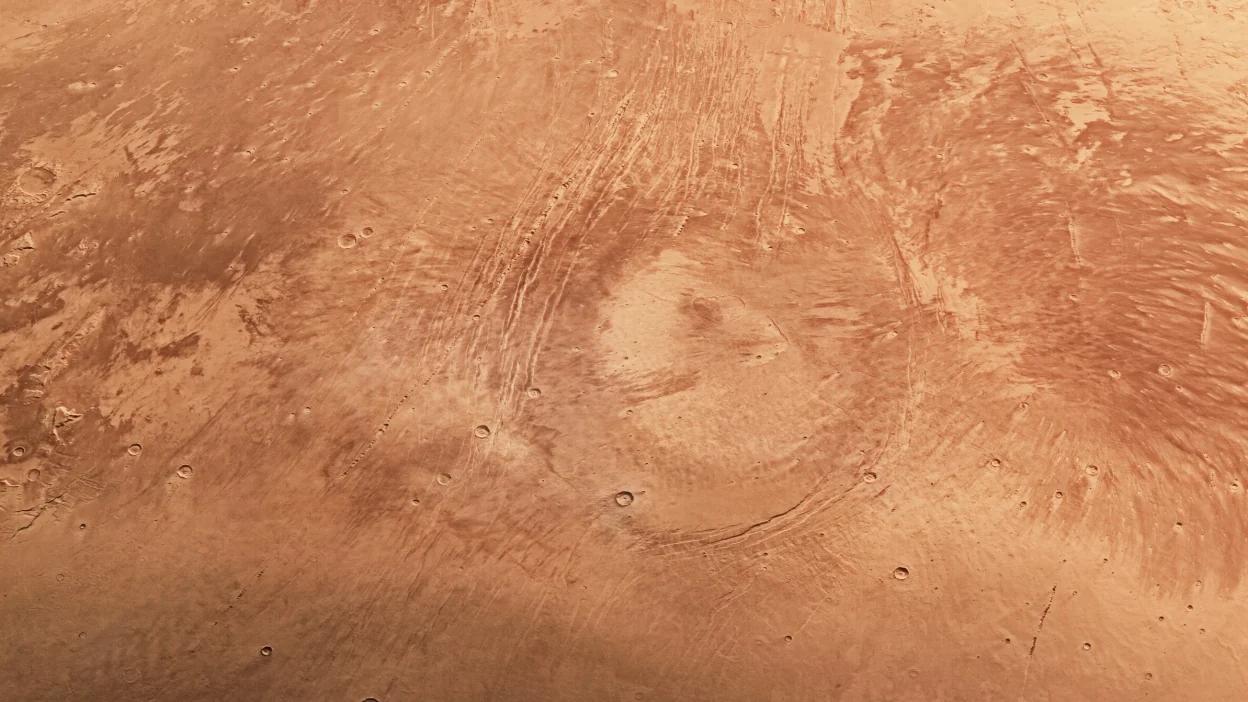
An international research team has identified potential signs of ongoing volcanic activity on Mars. Data from the European ExoMars Trace Gas Orbiter (TGO) revealed hydrogen chloride emissions above the Alba Mons volcano in the northern hemisphere. The gas appears consistently over a specific area characterized by a network of narrow surface fissures.
Researchers analyzed 78 TGO observations, noting a seasonal pattern where local gas spikes occur during early northern summers. The study suggests these fissures act as volcanic channels. Images from the CaSSIS camera on TGO and NASA’s HiRISE instrument show these cracks are only a few tens of centimeters wide, cutting through ice layers formed approximately 630,000 years ago.
The team proposes that ice seals the fissures during winter at temperatures reaching -120 °C, while summer sublimation allows volcanic gases to escape. Although sulfur dioxide was not detected, researchers note that terrestrial volcanoes can emit hydrogen chloride without significant sulfur dioxide output. This mechanism may also explain observed soil discoloration around the cracks.
These findings align with other evidence of recent geological activity in the Tharsis region, including lava flows and ash deposits dated to tens of millions of years ago. Additionally, the NASA InSight lander previously recorded marsquakes potentially linked to magma movement. Computer models indicate that internal planetary heat could support rock melting beneath the plateau.
If confirmed, the Alba Mons fissures could become primary targets for astrobiological research. Subsurface environments where heated rock interacts with water may provide the necessary thermal and chemical conditions to support microorganisms, protecting them from harsh surface conditions. However, the current evidence remains indirect, requiring further verification of the volcanic source.