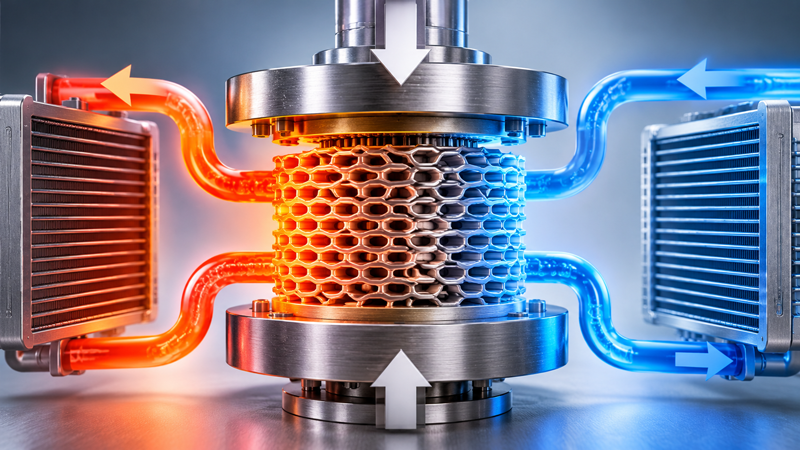
Researchers at the Hong Kong University of Science and Technology (HKUST) have developed a cost-effective manufacturing process for solid-state cooling elements. The technology utilizes elastocaloric cooling, which relies on the reversible phase transition of shape-memory alloys rather than traditional compressors and refrigerants.
The new design features a honeycomb-like structure made from thin NiTi alloy sheets. This architecture enhances heat exchange efficiency and prevents crack propagation, significantly improving durability. The elements have demonstrated the ability to withstand 100 million cycles, equivalent to 10 years of continuous operation.
The production method employs simple stamping, which allows for the manufacturing of up to 100 porous elements per minute. This process is over 100 times faster than wire electrical discharge machining (WEDM) and reduces production costs by 95 percent.
A prototype cooling module measuring 30 mm in length and containing 200 NiTi elements was tested. It achieved a maximum temperature difference of 11.7 K and a specific cooling capacity of 3.85 W/g. Future research will focus on developing the necessary heat transfer control systems and mechanical drives.