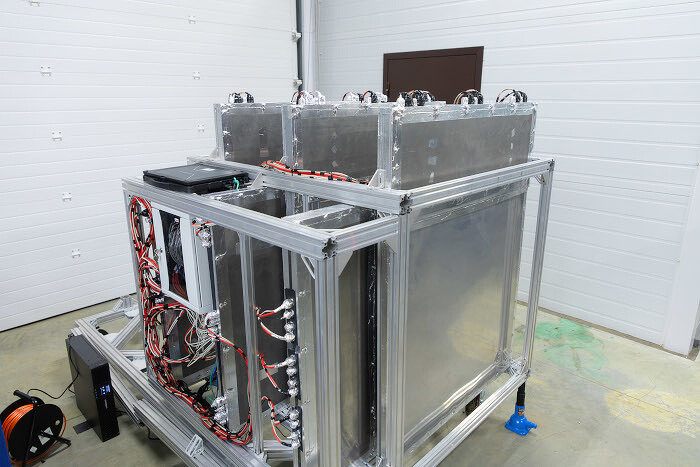
Researchers at the National Research Nuclear University MEPhI have completed testing of a new mobile muon hodoscope. The device is designed to study the internal structure of large-scale objects, such as reactors, tunnels, and bridges, using natural cosmic ray muon flux.
The hodoscope was developed at the NEVOD Scientific and Educational Center under the Priority 2030 program. It consists of six single-projection planes mounted on a mobile frame. Each plane contains two layers of 96 scintillation strips equipped with fiber optics and silicon photomultipliers, allowing for real-time track reconstruction.
The system is modular and can be disassembled into components measuring one meter by one meter. This design allows for deployment in confined or hard-to-reach spaces, such as subway tunnels, to identify geological risks like water-saturated soils.
According to the developers, the technology is safe and utilizes natural radiation. The project has already attracted interest from the Rosatom State Corporation. Currently, only 4-5 countries worldwide are developing muonography technology.