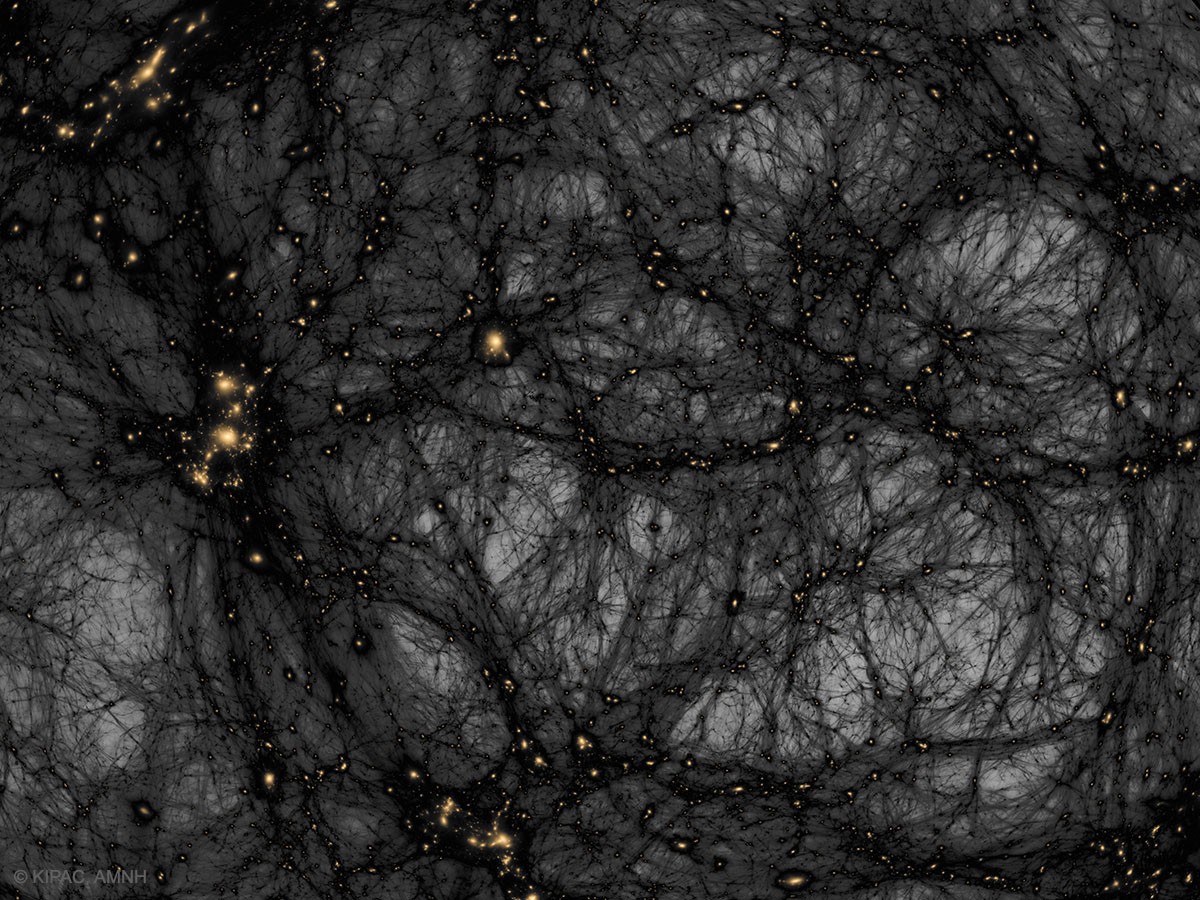
The American Museum of Natural History's Hayden Planetarium released a frame from its 'Dark Universe' space show. The visual presents a detailed computer simulation mapping the distribution of dark matter across the cosmos.
In this simulation, filaments of dark matter appear as black structures resembling spider webs. Clumps of baryonic matter, which represents familiar matter, are highlighted in orange throughout the frame.
Astronomers use these simulations to match statistical data from actual observations. Dark matter remains the primary explanation for observed galaxy rotation speeds, cluster orbits, and the effects of gravitational lensing.
The simulation also notes that dark energy is now considered the dominant source of repulsive gravity. This force currently drives the expansion of the universe, surpassing dark matter in its influence on cosmic structure.