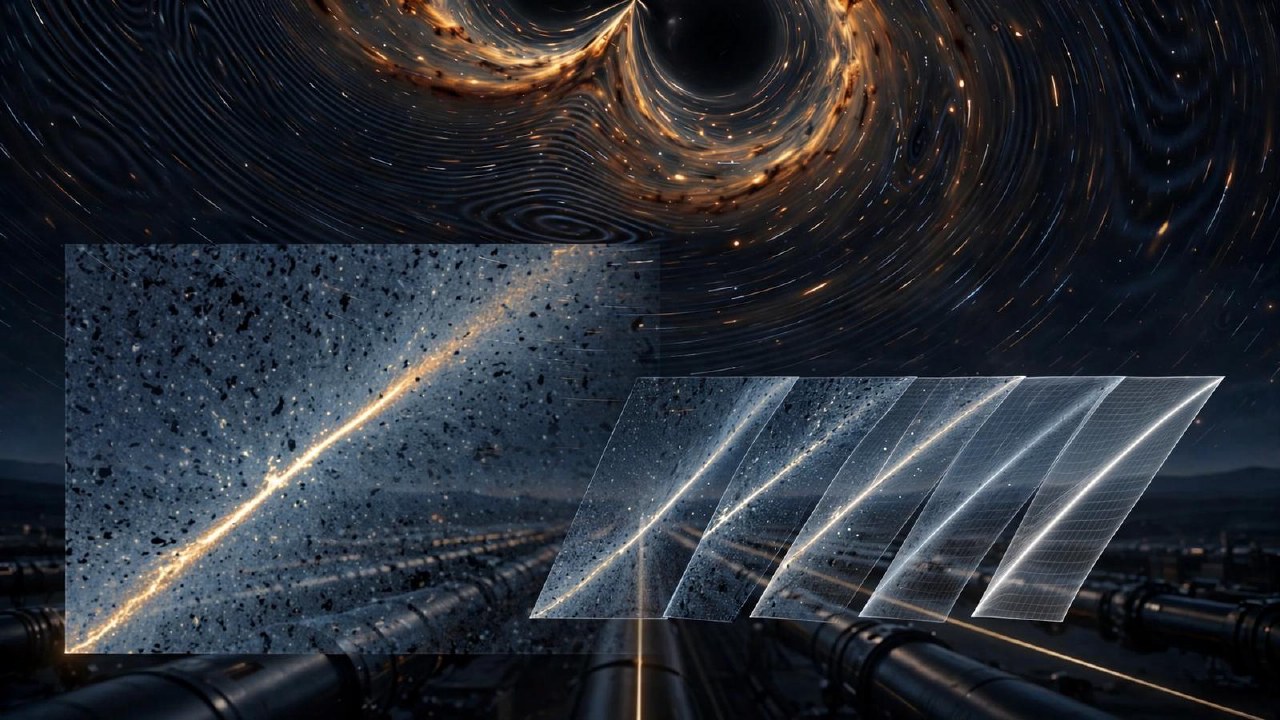
Researchers have tested a neural network named EasyResNet designed to detect gravitational waves from merging compact objects like black holes and neutron stars. The system operates by analyzing maps of signal-to-noise ratios, allowing it to distinguish between genuine astrophysical signals and noise patterns.
The new approach integrates neural networks with traditional matched filtering. Unlike standard methods, EasyResNet does not require the conventional chi-squared statistical test to filter out false positives, as it learns to identify signal characteristics directly from the data maps.
In four series of simulations, the algorithm demonstrated performance comparable to traditional methods. It showed superior results when signals deviated from pre-calculated templates or when data contained glitches, while maintaining high computational efficiency.
The system processes a single map in approximately 3 milliseconds on a standard CPU without special optimization. This efficiency is critical for future detectors like the Einstein Telescope, which will face significantly higher data loads.
The project is currently a proof of concept. Future work involves testing EasyResNet within the LIGO-Virgo-KAGRA collaboration pipelines to evaluate its impact on sensitivity and computational costs compared to existing full-scale systems.