

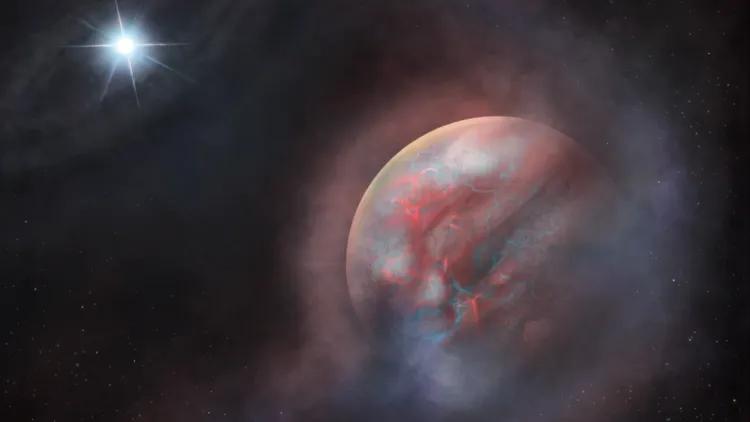
An international team of astronomers identified a second-generation planet orbiting the white dwarf HS 0209+0832. Observations from the NASA TESS telescope confirmed the object has a size comparable to Jupiter and completes an orbit every 4.4 days.
The planet likely formed from material ejected by the star during its final evolutionary stages. Researchers identified high concentrations of heavy elements, including zinc, copper, and niobium, in the white dwarf's atmosphere, with some levels 1000 times higher than solar values.
Scientists suggest the system may have been a binary star pair, where the companion's gravity helped retain ejected material to form a new disk. Currently, the white dwarf is stripping matter from the gas giant, allowing researchers to analyze the planet's chemical composition.
This discovery indicates that planetary formation can occur after a sun-like star dies. Astronomers plan to search for similar systems by monitoring white dwarfs for anomalous concentrations of heavy elements, which may serve as indicators of second-generation planetary bodies.



