

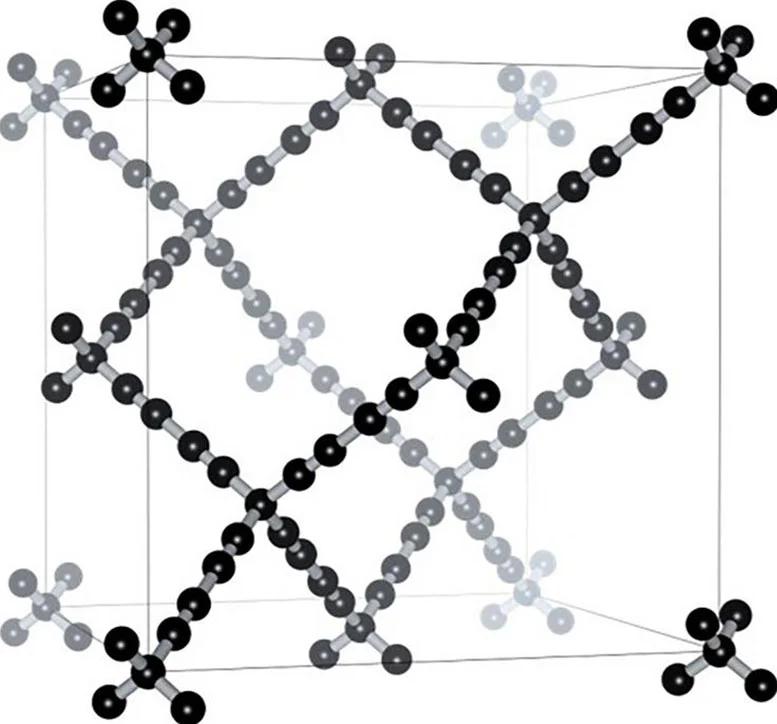
Researchers at the University of Gothenburg have successfully synthesized Diamondiyne, a new carbon allotrope that has existed only in theoretical models for 35 years. The material joins the carbon family alongside diamond, graphite, fullerenes, carbon nanotubes, and graphene.
Led by Professor Karl Börjesson, the team constructed a three-dimensional crystal structure by connecting carbon atoms with triple bonds. The resulting lattice consists of tetrahedral units linked at their vertices, creating a porous structure often described as porous diamond.
Unlike natural diamonds, Diamondiyne does not require extreme pressure to form. The researchers utilized relatively inexpensive equipment to induce carbon atom alignment at the interface of two liquids, creating a thin film.
Collaborating with Stockholm University and Chalmers University of Technology, the team confirmed the structure using advanced electron microscopy. They observed repeating lattice patterns consistent with theoretical predictions within a 10-nanometer area.
While large-scale production remains a future goal, the material's unique porous structure suggests potential applications in energy storage, batteries, electrocatalysis, gas storage, and advanced electronics.



