

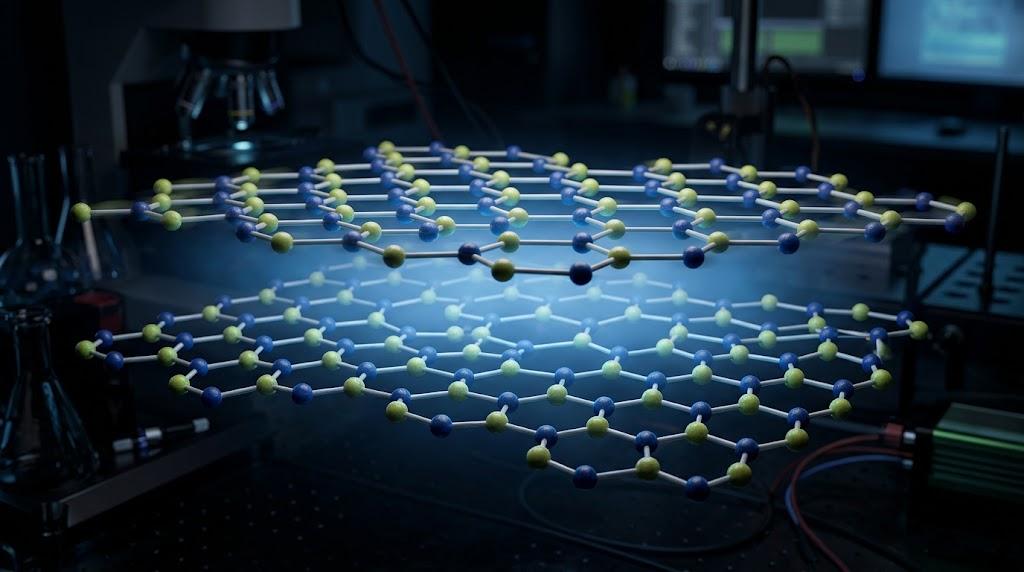
Researchers from Ningbo University, the Ningbo University of Technology, and the Ningbo Institute of Materials Technology and Engineering of the Chinese Academy of Sciences have developed a method to control atomic layer movement in sliding ferroelectrics. The team uses uniaxial strain to break crystal symmetry, creating a preferred path for layer displacement.
The study focuses on bilayer boron nitride, utilizing quantum calculations and AI-driven molecular dynamics simulations to analyze atomic behavior. By applying an electric field, the material shifts from a BA to an AB configuration, which effectively switches its electrical polarization.
The simulation results indicate that the polarization switching process takes approximately 1.7 picoseconds. This speed is three to four orders of magnitude faster than the switching rates observed in conventional ferroelectric materials.

